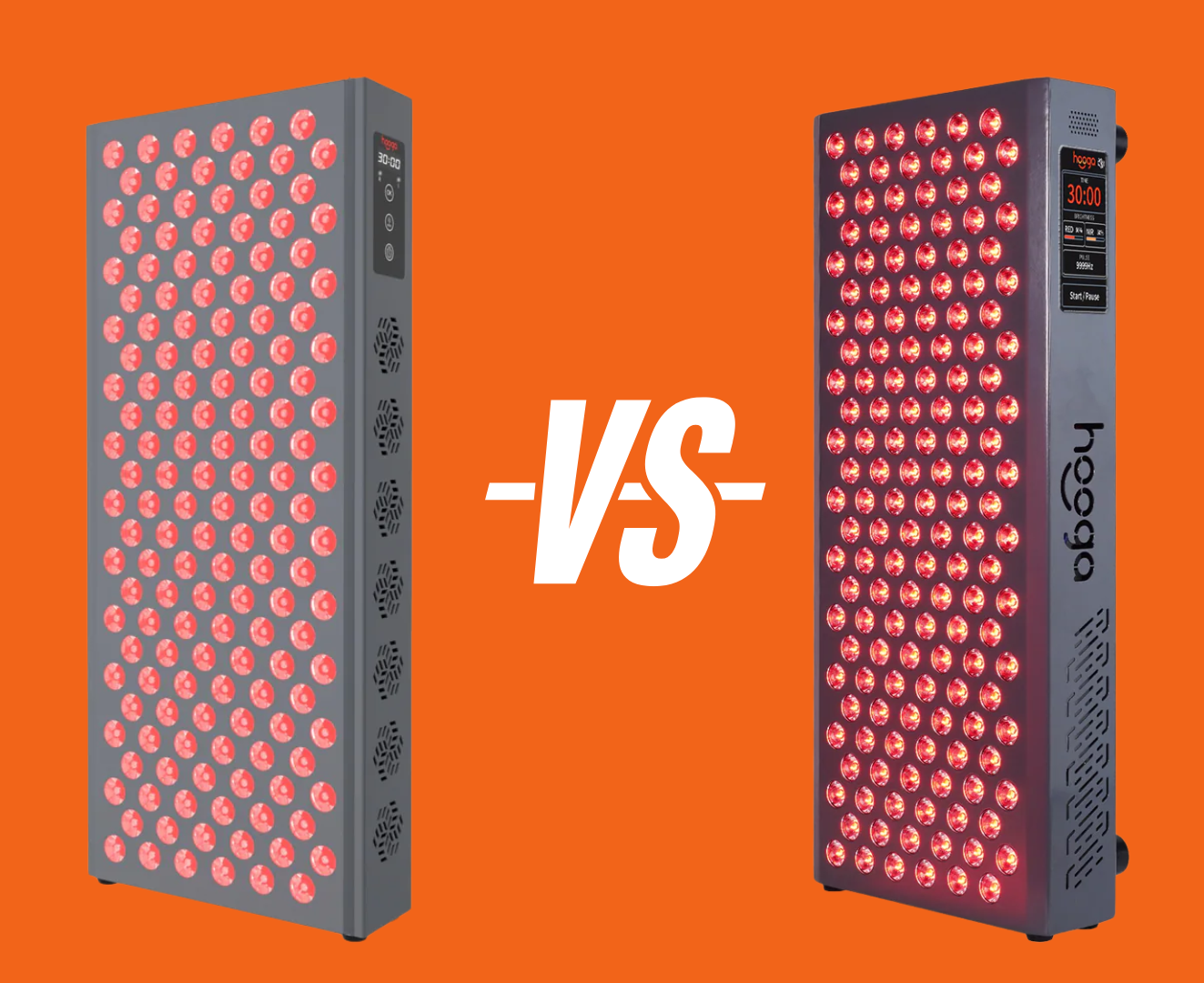
Hooga Pro vs Ultra – An Honest Look at Wavelengths, Power, and Price
If you’re comparing the Hooga PRO and ULTRA lines, you’re probably wrestling with the same question most buyers land on. Is it smarter to save money and get the simpler, high-output panel, or pay more for extra wavelengths, dimming, pulse mode, and quieter fans?
Hooga is one of many established brands in the consumer red light therapy market, known for pairing high irradiance with prices that undercut premium competitors.
But both lines are built for different buyers, and the choice usually has less to do with budget than with how you actually plan to use it.
This article covers how Hooga PRO and ULTRA compare on wavelengths, irradiance, controls, noise, and price, so you can match the right panel to your goals before you spend a dollar.
Hooga PRO vs ULTRA Overview
Hooga PRO vs ULTRA Specs: Full Side-by-Side Comparison
| PRO Series | ULTRA Series | |
|---|---|---|
| LED Technology | Dual-chip 5W | Quad-chip 5W |
| Wavelengths | 660nm + 850nm | 630 + 660 + 810 + 850nm |
| Irradiance at 6″ | >109–183 mW/cm² | >132–165 mW/cm²* |
| Controls | Digital timer + mode switch | Touchscreen + dimming + pulse |
| Dimming | ✗ | ✓ 1–100% |
| Pulse Mode | ✗ | ✓ 1–9,999 Hz |
| Modular Stacking | ✓ All models | ✓ All models |
| Fan Noise | Standard | Quieter |
| Warranty | ✓ 3 years | ✓ 3 years |
| Models Available | PRO300 · PRO750 · PRO1500 · PRO4500 | ULTRA360 · ULTRA750 · ULTRA1500 · ULTRA4500 |
| Where to Buy | Shop PRO Series → | Shop ULTRA Series → |
*Marketed irradiance. Independent spectrometer testing measures lower.
Disclosure: This article is reader supported and contains affiliate links.
Hooga PRO Series: Maximum Irradiance, Minimal Controls
People who step up to the Hooga PRO line are mostly after one thing – more power without more complexity.
Compared to Hooga’s entry-level HG panels, the PRO delivers higher irradiance through dual-chip LEDs. Each LED emits both 660nm red light and 850nm near-infrared simultaneously, which drives higher output numbers than the single-chip HG series.
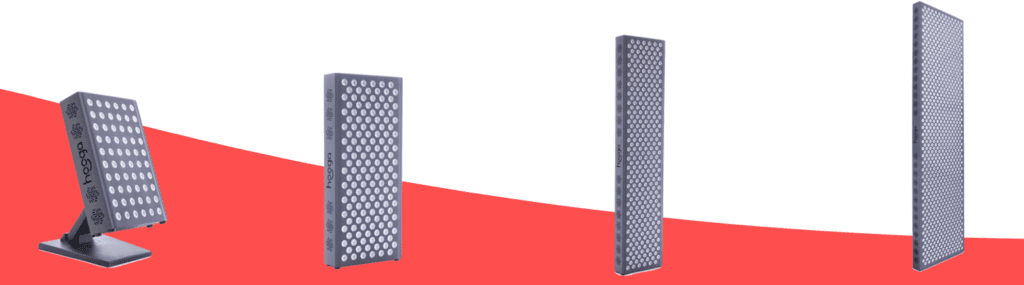
The PRO lineup spans four panel sizes, from the compact PRO300 up to the full-body PRO4500. The PRO300 is the most popular choice for the face, neck, joints, or a specific area while the PRO1500 is the go-to for full-body coverage.
Using a PRO panel is about as close to “one switch and away you go” as red light therapy gets. You just pick red, near-infrared, or both, set the timer, and you’re done.
No brightness to dial in, no pulse setting to configure, nothing to second-guess between sessions. For anyone who wants to get consistent daily sessions in, this simplicity is a big plus.
PRO panels are modular and compatible with Hooga’s vertical mobile stands. Stacking a PRO300 above a PRO1500 on a single stand is a popular setup for anyone treating multiple areas at once, covering shoulders to mid-shin without repositioning.
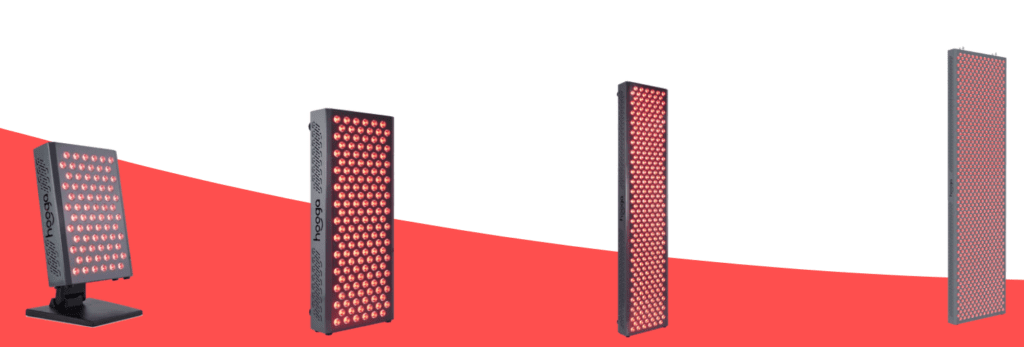
Hooga PRO Series: PRO300, PRO750, PRO1500 & PRO4500
Dual-chip 660nm + 850nm · Simple controls · Maximum output for the price
Hooga PRO300
Face, neck, joints — compact tabletop
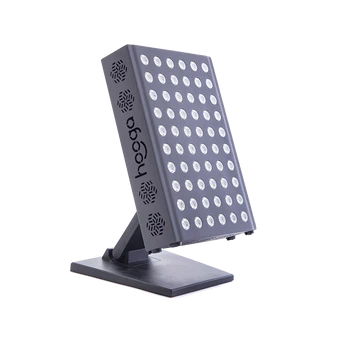
Hooga PRO750
Upper body coverage, door hang or stand
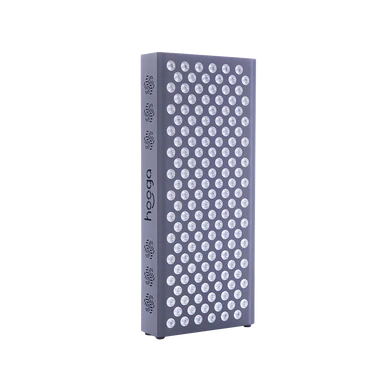
Hooga PRO1500
Full body sessions, maximum irradiance
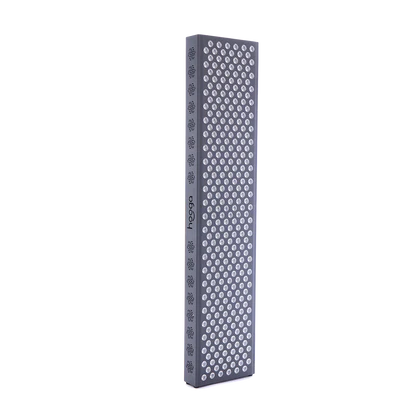
Hooga PRO4500
True full body — 5ft+ panel, 900 LEDs
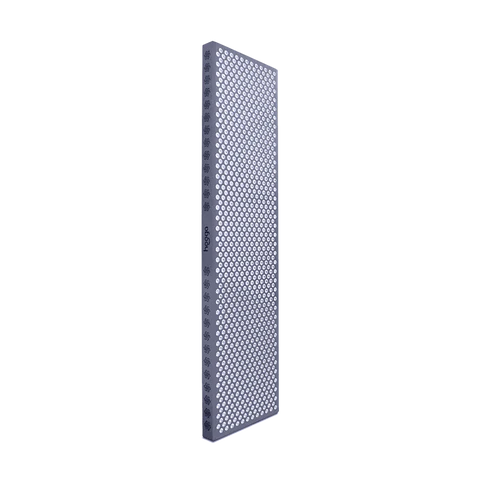
Hooga ULTRA Series: Four Wavelengths and Full Control Options
The Hooga ULTRA series upgrades to quad-chip LEDs, with each quad-chip LED emittings four wavelengths at once – 630nm, 660nm, 810nm, and 850nm.
You get the same core red and near-infrared wavelengths as the PRO, plus 630nm which has been studied for additional skin-surface effects, and 810nm which has a growing research base around inflammation, cellular respiration, and deeper tissue response.
Every ULTRA model has a digital touchscreen with brightness adjustable from 1% to 100%, a 30-minute timer, and pulse mode from 1Hz to 9,999Hz.
An included wireless remote lets you sync multiple panels if you are running a larger setup. Fan noise runs lower across the ULTRA line than the PRO.
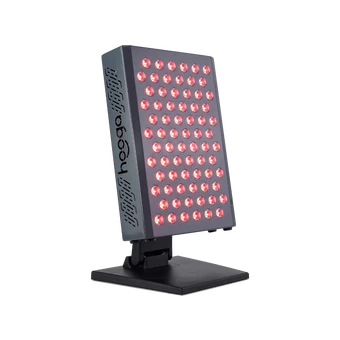
One thing worth knowing about the ULTRA360 before deciding is that it’s a tabletop panel with a built-in stand, designed to sit on a desk or vanity rather than hang from a door or attach to a vertical stand.
It cannot physically connect to other ULTRA panels in a stacked setup, though it can sync with them via remote. The ULTRA750, ULTRA1500, and ULTRA4500 are fully modular and hang-mountable.
Hooga ULTRA Series: ULTRA360, ULTRA750, ULTRA1500 & ULTRA4500
Quad-chip 4 wavelengths · Touchscreen controls · Dimming & pulse mode
Hooga ULTRA360
Face, neck, joints — 4 wavelengths, tabletop form
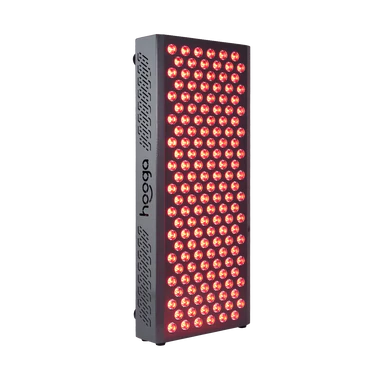
Hooga ULTRA750
Half body, 4 wavelengths, door hang or stand
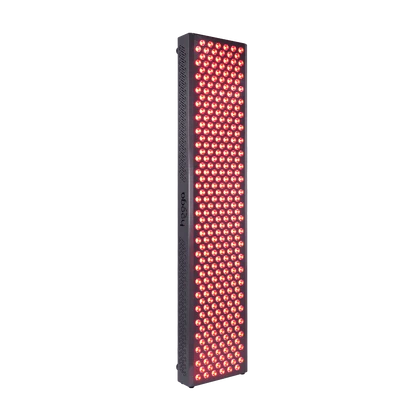
Hooga ULTRA1500
Full body, 4 wavelengths, full modular system
Hooga ULTRA4500
True full body — 5ft+ panel, 900 quad-chip LEDs
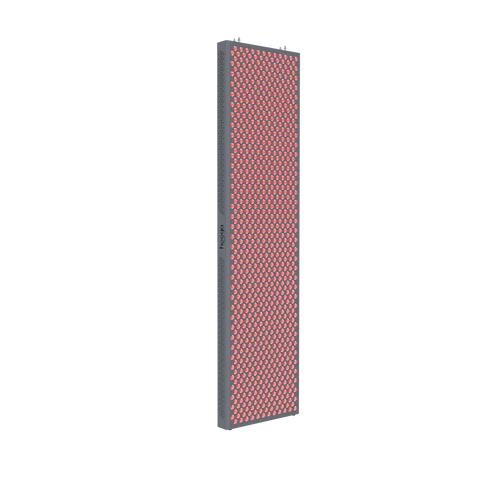
* ULTRA360 irradiance is manufacturer-reported using a solar meter.
Hooga PRO vs ULTRA Wavelengths: Do 630nm and 810nm Make a Difference?
This is where many buyers get stuck, so here’s the simple answer.
The PRO series uses 660nm and 850nm, two of the most widely used wavelengths in red and near-infrared light therapy research.
The 660nm wavelength is commonly used for skin-focused treatments, with research looking at collagen support and skin repair.
The 850nm wavelength is more often used for deeper-tissue applications. For most people shopping for a panel for skin, pain, or recovery, these are the core wavelengths they start with.
The Hooga ULTRA adds 630nm and 810nm. The 630nm wavelength may support additional skin-level benefits beyond what 660nm provides alone.
The 810nm has a growing research base around inflammation, neurological response, and cellular respiration.
One important thing to keep in mind is that consistency, distance, and session duration drive results more than the extra two wavelengths do. A PRO panel used daily will outperform an ULTRA panel used sporadically, regardless of spectrum.
If you want broader wavelength coverage and more ways to fine-tune your sessions, the ULTRA is the stronger choice. If you’d rather keep things simple and stick with the two most established wavelengths for everyday use, the PRO will do the job well.
Hooga PRO vs ULTRA Performance
Hooga PRO vs ULTRA Irradiance: How to Read the Numbers
Irradiance is the spec most buyers fixate on, and it’s worth understanding what the numbers actually mean before using them to choose a panel.
Both PRO and ULTRA panels publish irradiance figures measured at 6 inches. These numbers are useful for comparing models within the Hooga lineup relative to each other.
The PRO1500 at over 189 mW/cm² sits at the high end of the PRO range, and the PRO300 at over 109 mW/cm² is strong for a targeted panel. The ULTRA figures reflect the quad-chip design, with output spread across four wavelengths rather than two.
What the numbers do not tell you is exactly how to dose your sessions, because irradiance drops significantly as you move further from the panel. Most people use these panels from somewhere between 6 and 18 inches depending on their goal. A skin session up close is a very different dosing situation than standing back for full-body coverage.
Use the irradiance figures to compare panels against each other, not as precise targets to calculate your sessions against. Both series are high-output options in their price range and deliver meaningful light across the treatment area at recommended distances.
PRO vs ULTRA Controls: Simple Operation vs Full Customization
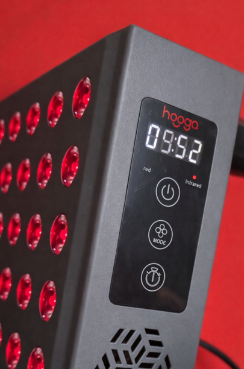
The PRO’s simple controls are one of its biggest selling points. Choose red light, near-infrared, or both, set the timer, and start your session. There are no advanced settings to manage and no extra setup before each use.
That ease of use is a big reason Hooga PRO panels appeal to first-time buyers. For beginners, the setup feels straightforward instead of intimidating.
Many people starting red light therapy worry about using the wrong settings. The PRO keeps that to a minimum by focusing on the two wavelengths most commonly used in published red light therapy research.
Aside from session length and light mode, there is very little to adjust, which makes it easier to use consistently.
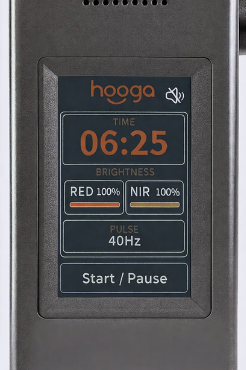
The ULTRA is designed for buyers who want more control over their sessions.
Adjustable brightness can be useful for closer-range skin treatments, since it lets you reduce intensity without moving the panel farther away.
It also adds pulse mode. Research on pulsed near-infrared light is promising, especially for tissue and neurological applications, but the evidence for at-home use is still less established than for standard continuous-wave therapy.
There’s also a wireless remote that’s useful once you’re running multiple ULTRA panels in a stacked setup.
If those features match how you plan to use the panel, the ULTRA’s controls are a genuine upgrade. If you want to press a button and walk away, the PRO is likely the better fit.
Hooga PRO vs ULTRA Fan Noise: Which Panel Is Quieter?
The ULTRA1500 measured around 44.5 decibels in independent testing, while the Hooga PRO1500 measured 50.5 dB.
In real use, neither panel is especially loud, but the ULTRA may be the better fit for people who plan to use their panel in a bedroom, shared space, or other quiet room.
Hooga PRO vs ULTRA EMF: What the Testing Shows
For most buyers, EMF is unlikely to be a deciding factor. Hooga markets its panels as low-EMF at recommended treatment distances, and third-party testing on specific models has generally found low readings in normal use.
How to Use a Hooga Panel: Distance, Timing, and What to Expect
Distance
Hooga recommends using panels from 6 to 18 inches away.
Closer means higher intensity and shorter sessions. Further back means lower intensity and longer sessions, which some people find more comfortable for full-body use. The irradiance figures on the product page are measured at 6 inches, so if you’re sitting further back your actual dose will be lower.
Session Length
Session length varies by goal and distance. Hooga recommends 2 to 15 minutes per area depending on how far away you are and what you’re treating.
Skin sessions close to the panel are typically on the shorter end. Sessions at greater distance for deeper tissue or recovery work tend to run longer. More time is not automatically better, and referring to Hooga’s included instructions are a good starting point.
Frequency
With any Hooga red light therapy panel, consistency matters most. Hooga recommends once-daily use as the standard, with twice-daily sessions as an option if they are spaced out. Regular use is what gives red light therapy the best chance to work over time.
As for results, Hooga says some users notice early changes within 1 to 4 weeks, more visible progress within 1 to 3 months, and better results after 3 to 6 months. Skin-related changes usually take the longest.
If your red light therapy results feel underwhelming, it’s worth revisiting your distance and session length to ensure your sessions have been optimized properly. Distance and session length are two of the biggest reasons people fall short of what they expected.
Hooga Pro vs Ultra Price Comparison: Is the ULTRA Worth the Extra Cost?
The PRO300 retails at $299 while the PRO1500 comes in at approximately $1,199. On the ULTRA side, the ULTRA360 is roughly $419 and the ULTRA1500 is about $1,399.
Compared with the PRO300, the ULTRA360 costs $120 more and adds two extra wavelengths, adjustable brightness, and pulse mode, giving you more control over how you run each session.
The PRO300, though, keeps things simpler from the start and costs less. Both offer strong value, so the better choice depends on whether you want the ULTRA360’s extra wavelengths and added controls or would rather have a more straightforward panel.
Higher up the range, the ULTRA1500 costs around $200 more than the PRO1500 and adds 810nm, pulse mode, and a touchscreen. For buyers who specifically want those upgrades, it still comes in well below the price of comparable panels from brands like PlatinumLED BioMax.
Hooga PRO vs ULTRA Verdict: Which Series Should You Buy?
Both the Hooga PRO and Hooga ULTRA series are built around the same core strengths that have made Hooga a popular name in red light therapy. You get strong irradiance, the wavelengths most buyers are looking for, and pricing that makes many premium red light therapy brands much harder to justify.
The difference comes down to how you want to use your red light therapy panel.
The Hooga PRO series is the better fit for buyers who want high output, the two most researched wavelengths, and a simple session that feels easy to repeat every day.
The PRO300 works well for targeted treatments, while the PRO1500 is better for full-body red light therapy. It’s straightforward, dependable, and easy to use consistently.
The Hooga ULTRA series is for people who specifically want 810nm, adjustable brightness, and pulse mode as part of how they use the panel. The ULTRA360 is a good option for face, neck and skin work, while the ULTRA1500 is designed for full-body sessions with broader four-wavelength coverage.
Like the PRO line, it comes with a three-year warranty and HSA/FSA eligibility, while still costing far less than many comparable panels from Joovv or PlatinumLED.
If you already know whether you want simple power or more advanced control, the choice becomes much easier, and either way, Hooga gives you a strong red light therapy panel for the money.
Hooga PRO Series
PRO300 · PRO750 · PRO1500 · PRO4500
- New to red light therapy and want a device built on the most-studied wavelengths
- Simple operation with no settings to configure
- You want the highest irradiance per dollar without paying for dimming or pulse
- Buying as a gift for someone who won’t want to fiddle with controls
- You plan to expand by linking multiple PRO panels on a stand later
Hooga ULTRA Series
ULTRA360 · ULTRA750 · ULTRA1500 · ULTRA4500
- You specifically want 810nm & 630nm alongside the core 660nm and 850nm wavelengths
- Adjustable brightness lets you vary your dose by distance and session goal
- Quieter fan operation matters for your room or shared space
- You follow PBM research and want pulse mode for NIR sessions
- You’re ready for Hooga’s most advanced home line, controls included
Hooga PRO vs ULTRA: Frequently Asked Questions
Is Hooga red light therapy safe for all skin tones?
Hooga says red light therapy is generally suitable for all skin tones and does not carry the same pigmentation risks as some other light-based treatments. That said, anyone with melasma, very reactive skin, or concerns about near-infrared exposure should start cautiously and follow Hooga’s usage guidance.
Which Hooga panel is best as a gift?
For most gift buyers, the Hooga PRO series is the safer choice because it is simpler to use and less intimidating than the ULTRA line. The PRO300 is the best gift for targeted face, neck, and joint use, while the PRO1500 makes more sense if you want a larger panel for shared or full-body use.
Can Hooga panels be purchased with HSA or FSA funds?
Yes. Hooga says its products are HSA/FSA eligible through its partnership with TrueMed, which lets eligible buyers use HSA or FSA funds for qualifying purchases.
Is the Hooga ULTRA really worth more than the PRO?
The ULTRA is worth paying more for if you specifically want 630nm and 810nm, adjustable brightness, and the pulse mode. If you want simpler everyday use with Hooga’s core 660nm and 850nm wavelengths, the PRO is usually the better value.
Which Hooga panel is best for skin and anti-aging?
For targeted skin and anti-aging use, the ULTRA360 is Hooga’s stronger tabletop option because it adds 630nm and 810nm plus dimming and pulse controls. If you want a simpler, lower-cost option focused on the two most established wavelengths, the PRO300 is still a strong choice.
How long does it take to see results from Hooga red light therapy?
Hooga says some people notice early changes within 1 to 4 weeks of consistent use, clearer results within 1 to 3 months, and more significant improvements in 3 to 6 months. Skin-related results are usually gradual, so daily consistency matters more than expecting a quick change after a few sessions.
Disclaimer: Red light therapy is not a substitute for medical treatment. Consult your healthcare provider before starting a light therapy protocol if you are managing a health condition. Individual results vary.