Red Light Therapy Wavelengths Explained: A Guide to Nanometers and Skin Benefits
Red light therapy wavelengths determine how light interacts with the skin, but more wavelengths do not automatically produce better results. For facial devices, red light around 630–660nm and near-infrared light around 830–850nm are commonly used in red light therapy for skin and supported by skin-rejuvenation research.
Red light is generally absorbed more superficially, while near-infrared can reach deeper tissue. Wavelength is only one part of the equation, however. Irradiance, treatment time, total dose, mask fit, and consistent use can all influence results.
This guide breaks down what the main red light therapy wavelengths do, whether two wavelengths are enough, and which specs to look at when choosing an LED face mask.
What Do Red Light Therapy Wavelengths Actually Do?
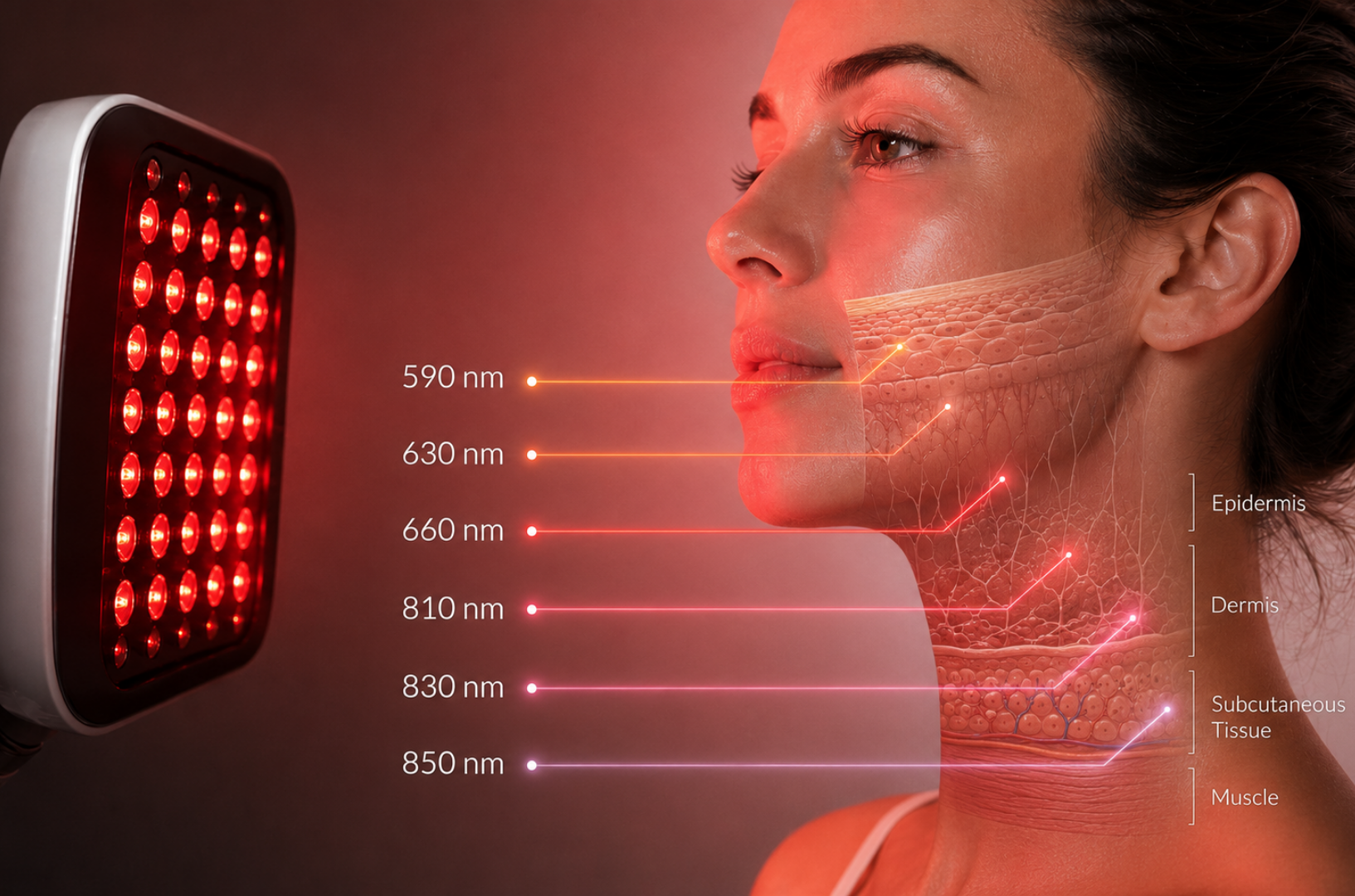
When you see numbers like 630nm or 850nm on the box, they tell you roughly how deeply each wavelength can reach.
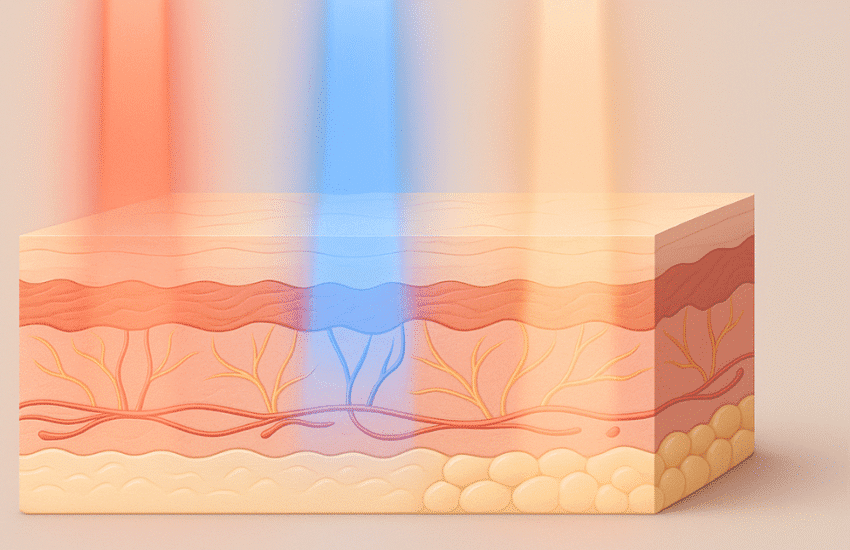
Red light around 630–660nm works closer to the skin’s surface, where it may help improve the look of fine lines, uneven texture and dullness. Near-infrared light around 830–850nm travels deeper into the dermis, supporting the processes involved in collagen and elastin production.
These wavelengths sit within the broader 600–1000nm range studied in photobiomodulation. But the exact nanometer is only part of the picture. Irradiance, treatment time and total dose determine how much light energy the skin actually receives.
How Red Light Therapy Wavelengths Work
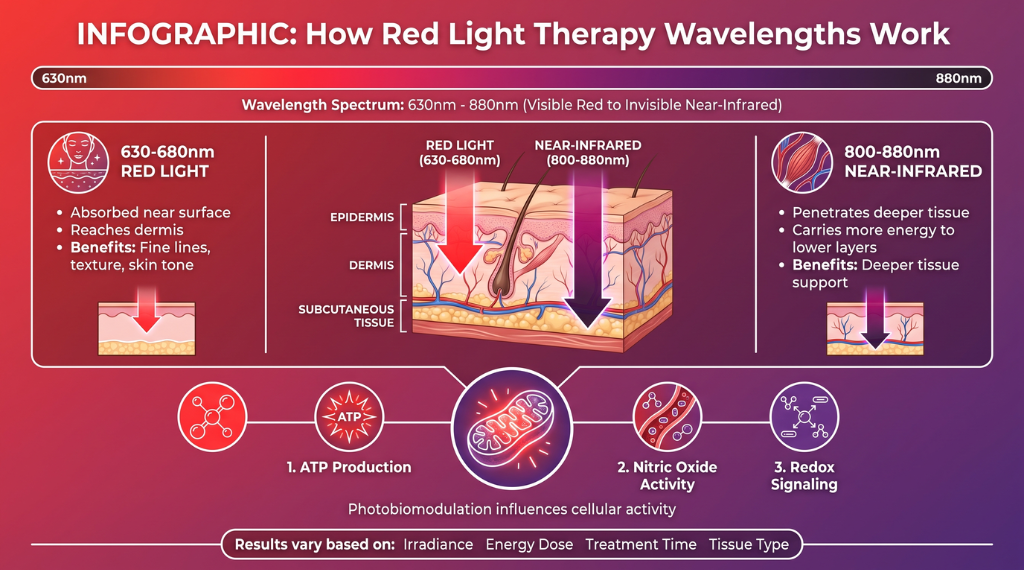
Red and near-infrared light, usually in the 630–880nm range, may affect how mitochondria and cells communicate.
Researchers think this may involve changes in ATP production, nitric oxide activity, and redox signaling, though they’re still working out how much each process contributes.
Together, these responses may support tissue repair and affect inflammation-related signaling. The results can vary based on more than wavelength alone, including irradiance, total energy dose, treatment time, and the tissue being targeted.
Red Light (600-700nm)
Red wavelengths in the 630–680nm range are generally absorbed closer to the skin’s surface than near-infrared light, though they can still reach parts of the dermis. Because of this, they’re commonly studied for concerns such as fine lines, uneven texture, and visible changes in skin tone.
Near-Infrared Light (800–880nm)
Near-infrared wavelengths, especially within the 800–880nm range, usually reach deeper tissue than visible red light. Both ranges can penetrate the dermis, but near-infrared light may carry more energy into deeper layers depending on the wavelength, irradiance, and device design.
Researchers have also studied red and near-infrared light together. Laboratory findings suggest this combination may support collagen and elastin production in human skin cells, though results from at-home devices can vary because the dose and treatment protocol play a major role.
These effects are produced through photobiomodulation, which aims to influence cellular activity without significantly heating the tissue. Mild warmth can still occur, especially with higher-output devices or enclosed designs.
For skin applications, the most commonly studied ranges are red light around 630–680nm and near-infrared light around 800–880nm.
Red Light (630–660nm) vs Near-Infrared (830–850nm)
These two wavelength ranges work at different depths, so they target different things.
- Red light around 630–660nm is generally absorbed more superficially and is commonly studied for visible concerns such as fine lines, texture and uneven tone.
- Near-infrared light around 830–850nm generally penetrates more deeply, although both red and near-infrared light can reach the dermis and interact with skin cells.
- Masks combining both ranges provide exposure at different tissue depths during the same session. Whether that produces better results than one wavelength depends on the device and treatment protocol.
There’s no evidence that a single wavelength within these ranges is best for everyone. Published studies and established device protocols use several wavelengths, including 633nm, 660nm, 830nm, and 850nm.
What matters more is how the device delivers the light. Irradiance, total dose, red light therapy frequency, and consistent use usually tell you more than a small difference in nanometers.
A mask that includes both red and near-infrared light covers the two ranges most often used in facial photobiomodulation. Even so, the listed wavelengths should be considered alongside the device’s irradiance and recommended treatment time.
Do You Need Multiple Wavelengths, or Are Two Enough?
More wavelengths on a specification sheet do not automatically produce better results. Research into facial skin rejuvenation commonly uses combinations such as 633nm with 830nm or 660nm with 850nm. These pairings expose the skin to both red and near-infrared light, covering different absorption and penetration profiles.
For someone primarily concerned with fine lines, texture, tone and firmness, a well-designed red and near-infrared device such as Mito Red Light’s MitoGLOW provide the wavelengths they need.
Additional wavelengths are most useful when they address another specific concern:
- Blue light around 415nm has antimicrobial activity and is used in some devices for mild acne. It may not suit every skin tone or sensitivity level.
- Deep near-infrared light around 1072nm is being studied for additional skin and deeper-tissue applications, but evidence that it improves facial results beyond established wavelengths remains limited.
- Additional red or near-infrared wavelengths may alter tissue absorption, but more channels do not guarantee a better clinical result.
Before buying a seven-wavelength panel, check whether each added wavelength maps to something you actually want to address. If acne is a concern, the best LED face masks for acne typically include a blue-light mode, though the device still needs to suit your skin tone and sensitivity level.
For most people, a combination of red and near-infrared light covers the main reasons for using a face mask. Any extra wavelength should serve a clear purpose rather than just make the spec sheet look more impressive.
Power Density: Why mW/cm² Matters More Than Wavelength
Most buyers focus on the nanometer number, which is understandable since it’s often the first spec a device highlights. But irradiance deserves just as much attention. Measured in milliwatts per square centimeter (mW/cm²), it shows how much light energy reaches the skin each second and helps determine the total dose delivered during a session.
The 630–660nm and 830–850nm ranges include some of the most studied red and near-infrared wavelengths for home use. But a device operating within those ranges at very low irradiance may not deliver enough energy to produce a measurable effect, even if the wavelength itself looks ideal on paper.
Here’s what to check before buying:
- Does the manufacturer publish an mW/cm² figure at all?
- Is that figure measured at the LED surface or at a set distance from the device?
- Is the irradiance measured at the point where the light reaches the skin? Many consumer masks report figures in the tens of mW/cm², but there is no universal ideal range. The number should be assessed alongside session length and the resulting energy dose in J/cm².
- Does the brand explain how session time connects to dosage?
Total energy dose is calculated by multiplying irradiance by treatment time, with the units converted to J/cm². In general, a lower-irradiance device needs a longer session to deliver the same surface dose.
Even then, two devices delivering the same surface dose may not produce the same biological response. It’s best to follow the treatment protocol provided for the specific device. When a brand doesn’t publish its irradiance, dose, or measurement method, it becomes much harder to compare its output with tested devices.
What to Look for When Buying a RLT Face Mask
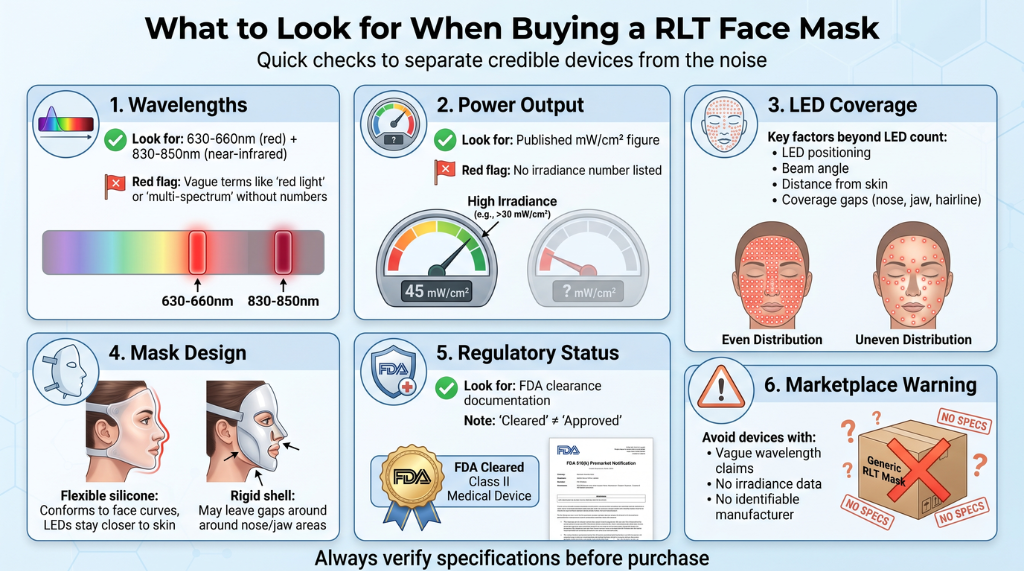
Specs can vary widely between at-home red light therapy devices, but a few quick checks can help separate credible masks from the noise.
– Wavelengths: Look for explicit numbers, specifically 630-660nm for red and 830-850nm for near-infrared. Vague language like “red light” or “multi-spectrum” without figures is a sign the brand can’t back the claim.
– Published mW/cm²: Reputable masks list their irradiance figure. No number means no way to verify the device is outputting anything useful.
– LED placement and coverage: LED count alone does not prove that a mask provides even coverage. The position of the LEDs, beam angle, distance from the skin and gaps around the nose, jaw and hairline are also important considerations.
– Flexible silicone vs. rigid shell: Flexible masks usually sit closer to the curves of the face, which can keep the LEDs closer to the skin. Rigid shells may leave more space around areas like the nose and jaw, where the face naturally curves inward.
– Regulatory documentation: In the United States, FDA clearance shows that a device has been reviewed for its stated intended use and found substantially equivalent to an existing legally marketed device. Note that FDA-cleared does not mean FDA-approved.
– Marketplace devices: Be cautious when a listing provides vague wavelength claims, no irradiance measurement and no identifiable manufacturer. Without published specifications, its output is difficult to verify.
Eye Safety and Avoiding Overexposure
Red and near-infrared masks are generally considered low risk when used according to the manufacturer’s instructions, but device designs and light intensities vary.
- Use the supplied eye inserts or protective glasses for red light therapy when directed.
- Avoid staring directly into exposed LEDs or a high-powered panel at close range.
- Follow the recommended treatment time rather than extending sessions to try to accelerate results.
- Mild warmth may occur, but stop using the device if you experience persistent redness, burning, eye pain, headaches or changes in vision.
- Take additional care with blue-light modes, which have different ocular considerations from red and near-infrared light.
- Speak with a doctor before use if you have an eye condition, a photosensitive disorder or take medication that increases light sensitivity.
Closing your eyes may improve comfort with some devices, but it should not replace the manufacturer’s eye-safety instructions. Panel users should follow the brand’s recommended distance and use protective eyewear when required.
The Bottom Line on Red Light Therapy Wavelengths
For facial use, 630–660nm red light and 830–850nm near-infrared light cover two of the most commonly studied ranges. Red light is generally absorbed more superficially, while near-infrared can reach deeper tissue, although both ranges may influence cells within the dermis.
Irradiance and treatment time matter alongside wavelength because they determine the surface energy dose. A device with the right wavelengths may still deliver limited results if its output, coverage or treatment protocol is inadequate.
Before buying, check that wavelengths are listed explicitly on the spec sheet, confirm a published mW/cm² figure is available, and match the device to your use case, whether that’s surface skin work, deeper tissue support, or both.
FAQ: Red Light Therapy Wavelengths
Is Red Light Therapy Backed by Real Science?
Yes, LED skin phototherapy treatments are supported by peer-reviewed laboratory and clinical research, although the strength of evidence varies by use, wavelength and treatment protocol.
Red and near-infrared light may influence mitochondrial and cellular signaling, including ATP production, nitric oxide activity and redox pathways. Research also suggests that these wavelengths may support collagen and elastin production in human skin cells. However, some of this evidence comes from laboratory studies rather than trials of consumer face masks.
Clinical studies of at-home devices are often small, and results are usually gradual. The presence of a studied wavelength does not prove that every mask delivers a clinically useful dose.
What Is the Ideal Wavelength Range for Red Light?
The most studied red light therapy wavelengths fall within the red and near-infrared ranges. For skin applications, research commonly focuses on red light between 630–680nm and near-infrared light between 800–880nm.
Within these ranges, 660nm and 850nm are among the most widely studied wavelengths, while 633nm and 830nm are also used in established device protocols.
A device that falls outside these ranges isn’t automatically ineffective. Still, choosing wavelengths that align with published research makes it easier to compare the device with studied treatment protocols. Wavelength is only one part of the picture, so irradiance, total dose, treatment time, and consistency should also be considered.
Do 7-Wavelength Panels Beat 2-Wavelength Devices?
Not necessarily. A device with seven wavelengths has not automatically been shown to outperform a device using two well-studied wavelengths.
For facial skin concerns, combinations such as 633nm with 830nm or 660nm with 850nm cover the red and near-infrared ranges commonly used in photobiomodulation research. Additional wavelengths may be worthwhile when they address another specific concern, such as blue light for mild acne.
When comparing devices, place more weight on the complete treatment protocol, coverage, irradiance and clinical testing than on the number of wavelengths listed.
Can Red Light Masks Damage Your Eyes?
Red and near-infrared masks are generally considered low risk when used according to the manufacturer’s directions, but they can be intensely bright and eye-protection requirements vary by device.
Use the supplied eye inserts or protective eyewear when directed, and avoid looking directly into exposed LEDs. Blue-light modes require additional caution because blue light has different retinal effects from red and near-infrared light.
Anyone with an existing eye condition, unusual light sensitivity or a prescription for photosensitizing medication should speak with a doctor before using an LED mask. Stop using the device and seek medical advice if you experience eye pain or changes in vision.
What Power Density and Time Do I Need?
There is no universal power density or session length that suits every red light therapy mask. Irradiance must be considered alongside treatment time because together they determine the surface energy dose.
Many at-home masks report irradiance in the tens of mW/cm², but a higher figure is not automatically better. A higher-output mask may use a shorter session, while a lower-output mask may require more time. Measurement distance and testing method can also affect the published number.
Follow the manufacturer’s tested treatment time and frequency rather than applying a general 10–20 minute rule across every device.
Health Disclaimer: This information is for educational purposes only and isn’t a substitute for professional medical advice, diagnosis, or treatment. Red light therapy is not intended to diagnose, treat, cure, or prevent any disease.