Will Red Light Therapy Help Sunburn or Make It Worse?
Will red light therapy help with sunburn, or will it make things worse? If you’ve ever dealt with that hot, tight feeling after too much sun, you’re probably desperate for anything that speeds up healing.
Red light therapy has become popular for skin issues, but sunburn is tricky. Your skin is already inflamed and damaged, so adding more light, even therapeutic light, might sound counterintuitive. The short answer: it depends on timing, wavelength, and how bad your burn is.
Let me walk you through what actually happens when you use infrared light on sun-damaged skin, when it might help, and when you should absolutely skip it.
How Red Light Therapy Actually Works on Skin
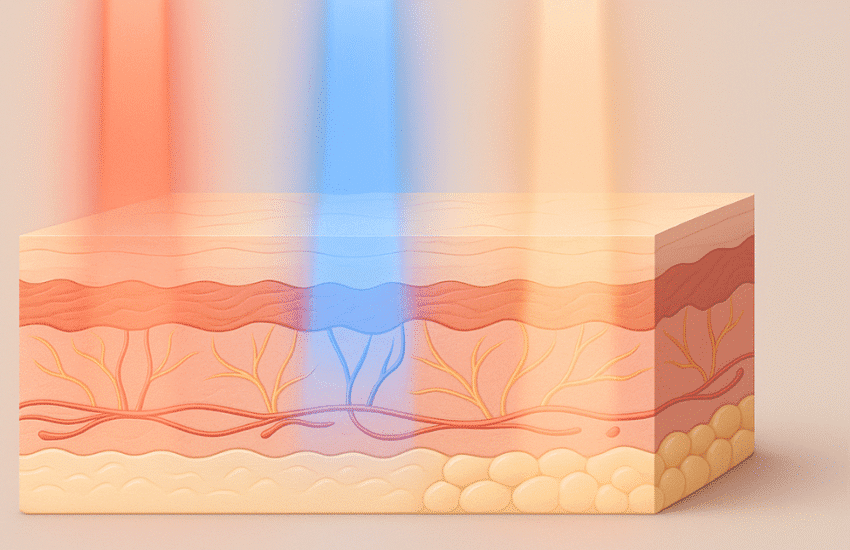
Red light therapy uses specific wavelengths of red and near-infrared light, typically in the 630 to 850 nm range, to reach the skin and underlying tissue. These wavelengths are believed to support normal cellular function by interacting with the mitochondria, the parts of cells responsible for energy production.
As a result, red light therapy is often used to support skin renewal and improve the appearance of fine lines and other visible signs of skin stress. It can be a useful addition to a skincare routine focused on keeping skin looking calm, healthy, and refreshed.

- Red light (630-660nm) penetrates surface layers of skin
- Near-infrared (850nm) reaches deeper tissue and promotes cellular repair
- Mitochondria absorb light energy and convert it to ATP
- Increased ATP production accelerates healing processes
- Timing matters. Acute damage responds differently than chronic issues
The Problem With Using Light Therapy on Fresh Sunburn
That hot feeling from a fresh sunburn isn’t trapped heat from the sun – it’s inflammation. Your blood vessels have dilated to rush immune cells to the damaged area, making your skin feel warm and tight.
Red light therapy sits in a different category from lying in the sun. At the doses used in photobiomodulation, red and near-infrared light mostly work through non-thermal, photochemical effects, meaning they nudge mitochondria and cell signalng, rather than cooking your skin the way strong sunlight or a heat lamp would.
So does that mean you should blast a fresh sunburn with your red light panel? Not so fast.
The research we do have so far is mostly about pre-conditioning the skin. Some research suggests photobiomodulation may help skin tolerate stress differently when used before injury, but that is not the same as proving it is a reliable at-home treatment for fresh sunburn.
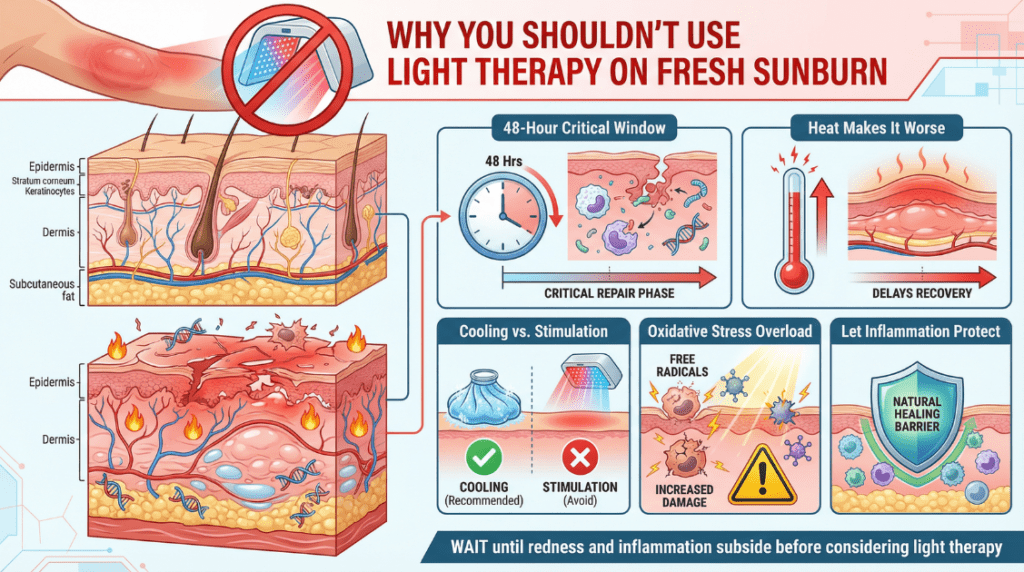
What we don’t really have yet are good human trials where someone gets an actual sunburn and then uses red light immediately afterward, with clear data on pain, healing time, or peeling. On the flip side, standard burn and sunburn care still says the same thing it always has:
- Cool the area
- Avoid extra heat
- Use soothing topicals and pain relief as needed
Remember, a lot of home red light devices get warm just from the electronics. On normal skin that’s no big deal; on raw, inflamed, “don’t even touch me” sunburn, pressing a warm panel right up against it is a recipe for misery, whether or not the photons are doing something helpful underneath.
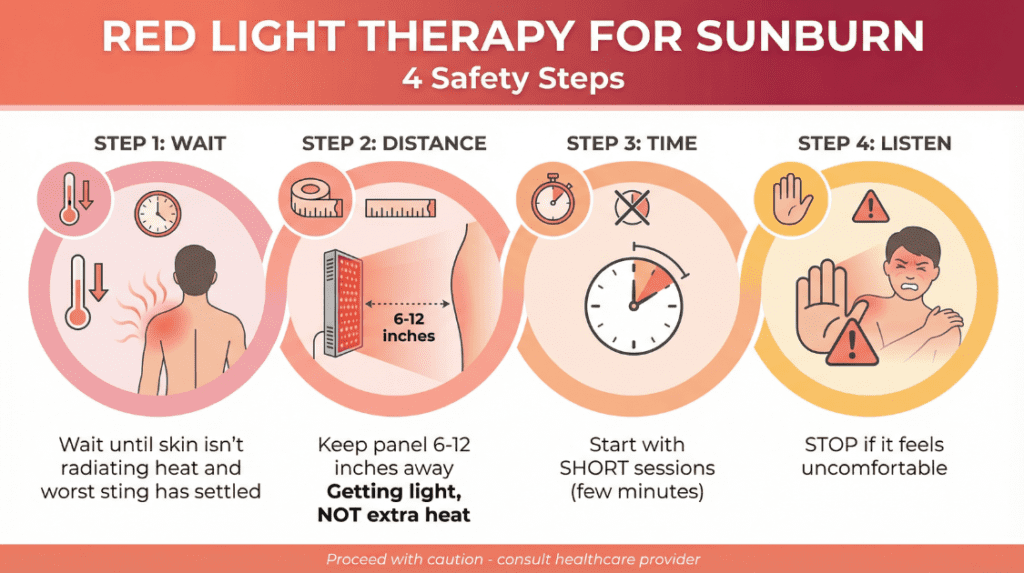
If you’re determined to experiment with red light at home around a sunburn, a more cautious approach looks like this:
- Wait until the heat and worst stinging have clearly settled before considering any light device at home.
- Keep the panel back a bit (for example, 6–12 inches away) so you’re getting light, not extra heat.
- Start with shorter sessions (5-10 minutes maximum), not a long session.
- Stop if it feels uncomfortable
Red light therapy might speed up healing for sun-damaged skin, especially in the recovery phase, but it won’t replace the basics: stay out of the sun, wear sunscreen, and take care of the burn properly. If your sunburn is severe, blistered, or covers a large area, skip the light panel and see a doctor.
When Red Light Therapy Might Actually Help Sunburn Recovery
Once you’re past the acute phase (usually 72+ hours after burning) red light therapy might speed up the healing process. At this point, your skin has moved from crisis mode to repair mode, and that’s when cellular energy boost becomes useful.
Some experimental and animal studies suggests 660 nm red light may support wound-healing pathways, but that does not prove the same benefit for fresh sunburn in humans.
What Wavelengths and Settings Matter for Sun-Damaged Skin
Not all red light therapy devices are equally suited to sun-damaged skin, especially when the area is still inflamed, tender, or heat-sensitive.
For surface-level skin concerns, red light in the 630nm to 660nm range is generally the most relevant because sunburn affects the upper layers of the skin. Near-infrared light such as 850nm penetrates more deeply and is more commonly used in devices designed for muscles, joints, and deeper tissues.
There is some preclinical research suggesting photobiomodulation may support burn wound healing, but that is not the same as proving that fresh sunburn should be treated with high-output red light devices at home.
When skin is already compromised, a more cautious approach makes sense. Lower-intensity devices and shorter sessions are generally a better starting point than high-output panels or long exposures, especially if the device produces noticeable warmth during use.
The goal is to avoid adding extra irritation to already stressed skin. If the area still feels hot, painful, or highly inflamed, standard sunburn care should come first, and any light-based device should wait until the skin has clearly calmed down. For severe, blistering, or worsening sunburn, medical care is the better next step.
Better Alternatives for Sunburn Relief
Honestly, red light therapy shouldn’t be your first choice for fresh sunburn. Cold compresses, aloe vera, and anti-inflammatory medications work better for immediate relief because they address what your skin actually needs: cooling and hydration.
Your burned skin has lost moisture and barrier function. Light therapy should not be your first-line approach during the acute phase, when cooling, hydration, and soothing skin care are more directly aligned with what sunburned skin needs.
- Apply cold compresses for 15-20 minutes every few hours
- Use pure aloe vera gel to soothe and hydrate damaged skin
- Take ibuprofen or aspirin to reduce prostaglandin-driven inflammation
- Apply fragrance-free moisturizer once initial heat subsides
- Consider red light therapy only during the rebuilding phase (days 3-14)
Signs You Should Skip Red Light Therapy Entirely
Some sunburns are too severe for any at-home treatment, including red light therapy. If you have blistering, fever, chills, or severe pain, you need medical attention, not a light panel.
Even for moderate burns, if your skin feels hot to the touch or looks bright red, it’s not ready for light therapy. Wait until the heat subsides and the color shifts from angry red to pink. Your skin will tell you when it’s ready – it’ll stop feeling like it’s radiating heat.
- Blistering indicates second-degree burns requiring medical evaluation
- Fever, chills, or nausea signal possible sun poisoning
- Broken skin barrier increases infection risk with any treatment
- Bright red, hot-to-touch skin is too inflamed for light exposure
- Severe pain lasting beyond 48 hours warrants professional assessment
The Bottom Line: Will Red Light Therapy Help with Sunburn?
For fresh sunburn, red light therapy is usually not the best place to start. If your skin is still hot, tender, or visibly irritated, light therapy may feel uncomfortable and is unlikely to be as helpful as basic after-sun care.
Your first priority should be cooling the skin, staying hydrated, avoiding more sun exposure, and managing discomfort with standard sunburn care.
Once the skin has moved past the most reactive stage, some people use red light therapy as part of a gentle recovery routine. At conservative settings, it may help support the skin’s natural recovery process and improve the appearance of lingering redness or dryness as the skin settles.
Keep sessions short, use caution, and stop if the area feels warmer, more sensitive, or more irritated.
The better approach is to think of red light therapy as optional support later in the recovery phase, not an emergency treatment for early sunburn. Prevention still matters most, so sunscreen, shade, and protective clothing should always come first.
Disclaimer: This content is for informational and educational purposes only and is not a substitute for professional medical advice, diagnosis, or treatment. Always talk to your doctor or another qualified health provider before starting any new treatment, including red light therapy. Never ignore or delay seeking medical advice because of something you read online.