How to Use Red Light Therapy for Knee Pain
If red light therapy hasn’t made much difference to your knee pain, the problem may be less about the light itself and more about dose, placement, and treatment frequency.
Knee photobiomodulation studies have used near-infrared wavelengths between 785 and 860 nm, with around 4 to 8 joules delivered per treatment spot. At home, reaching a comparable dose depends on your device’s irradiance, how far it sits from the knee, and how consistently you use it.
Placement also affects how much of the joint gets exposed. Treating only the front of the knee can miss the medial, lateral, and posterior areas that may also be involved in pain and stiffness.
This guide covers where to place red light therapy on the knee, how often to use it, how long sessions should last, and how panels, wraps, and laser devices differ.
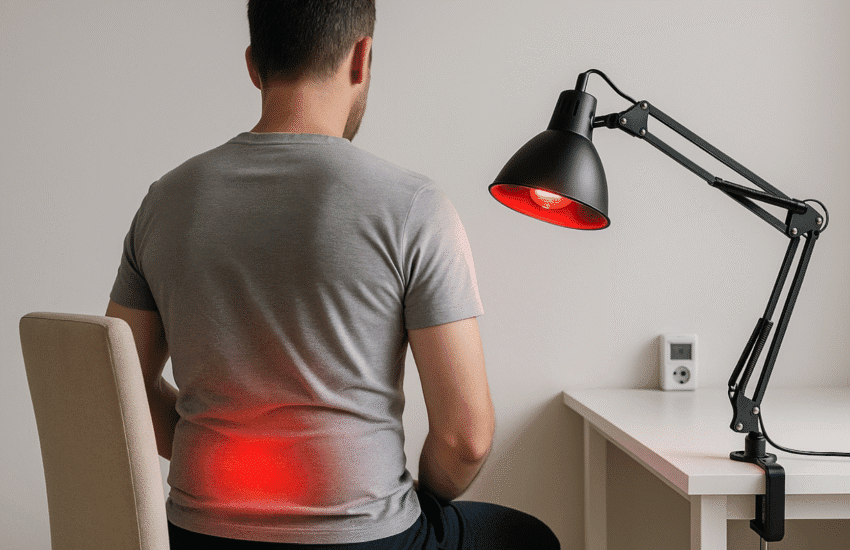
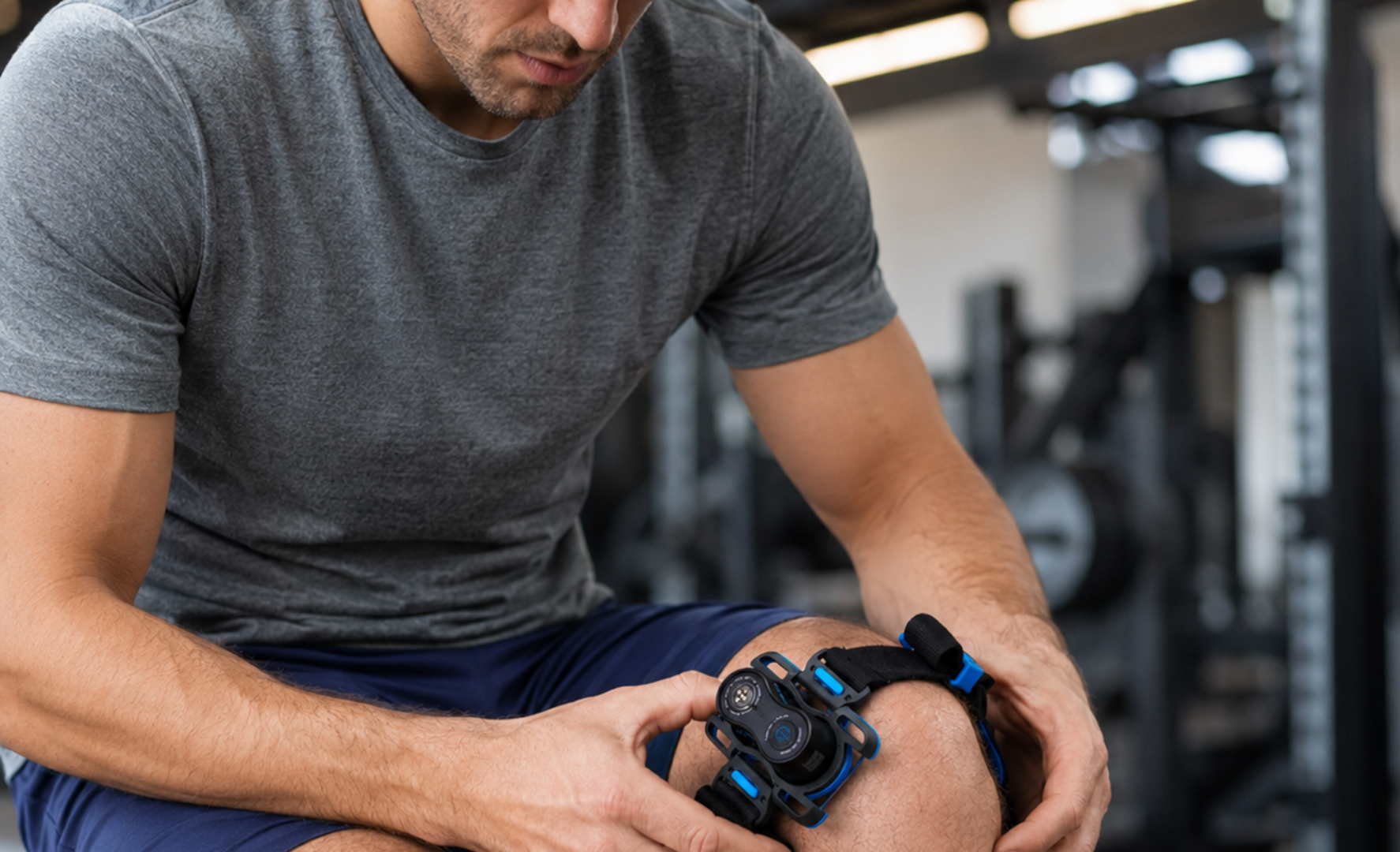
If holding a panel or handheld device in position is inconvenient, a wearable option such as the Kineon Move+ straps around the knee for hands-free treatment and keeps the emitters at a fixed distance from the skin.
What Red Light Therapy Does to Knee Tissue: 660nm vs 808-850nm
Red vs Near-Infrared Light for Knee Pain
Knee light therapy research has tested several wavelengths, with near-infrared light from roughly 785 to 905 nm especially well represented. Red light around 660 nm has also been studied. The main difference between visible red and near-infrared light is how deeply each penetrates tissue.
- Red light at 660 nm is absorbed more superficially, making it better suited to the skin, patellar tendon, and shallow tissues around the kneecap.
- Near-infrared light penetrates deeper into soft tissue than visible red light, allowing more of the emitted light to reach deeper layers around the knee joint.
This difference in penetration helps explain why wavelength choice can affect results. If a red light therapy device emits visible red light only and your knee pain comes from deeper inside the joint, less light may reach the tissue you’re trying to target.
Research on red light therapy for knee osteoarthritis has tested several wavelengths, including 660 nm red light, 808 to 850 nm near-infrared, and 904 to 905 nm laser light. Some devices combine red and near-infrared wavelengths, while many clinical studies use a single near-infrared wavelength.
Using both red and near-infrared light can provide a broader range of tissue penetration, with red light acting closer to the surface and near-infrared travelling deeper into soft tissue around the knee.
At the cellular level, red and near-infrared wavelengths are thought to interact with mitochondrial chromophores, particularly cytochrome c oxidase. Research suggests this interaction may affect ATP production, reactive oxygen species, and inflammatory signalling in stressed tissue, although the exact mechanisms are still being studied.
For people comparing devices for red light therapy for knee pain, combining roughly 660 nm red light with 808 to 850 nm near-infrared light can give broader tissue exposure than red light alone, with red acting closer to the surface and near-infrared penetrating further into soft tissue around the knee.
What Photobiomodulation Can and Can’t Change in Knee Osteoarthritis
Before using red light therapy for knee pain over several weeks, it helps to set realistic expectations.
Knee osteoarthritis research has focused mainly on changes in pain, stiffness, and physical function, rather than repairing damaged joint structures.
Cartilage loss and joint space narrowing are structural signs of knee osteoarthritis. Current evidence doesn’t show that photobiomodulation can regrow lost cartilage or reverse joint space narrowing once it has developed.
Where photobiomodulation may help is with the symptoms linked to knee osteoarthritis.
Pain and stiffness aren’t caused by cartilage loss alone; inflammation, changes in pain signalling, and irritation of tissues around the joint can also play a role. Red light therapy may influence some of these processes even though it doesn’t repair the underlying cartilage damage.
So the aim of red light therapy for knee osteoarthritis is typically less pain, less stiffness, and easier movement. It shouldn’t be presented as a treatment that rebuilds cartilage or reverses established structural damage inside the knee.
Where to Place the Device: An 8-Point Knee Coverage Map
Photobiomodulation dose is usually expressed in joules per square centimetre (J/cm²). It’s also one of the easiest details to overlook when choosing an at-home red light therapy device for knee pain.
Guidance from the World Association for Photobiomodulation Therapy lists minimum doses of about 4 joules per treatment point for knee joints when using wavelengths in the 780 to 860 nm range.
A 2019 meta-analysis of knee osteoarthritis trials found reductions in pain and disability with 4 to 8 joules per treatment spot using 785 to 860 nm lasers.
However, those figures need some context. Many studies use clinical laser systems with controlled output and professional supervision, while consumer red light devices can differ greatly in irradiance, beam area, distance, and treatment time.
For that reason, research doses are better used to understand a device’s specifications than copied as a home treatment plan. Follow the manufacturer’s instructions for treatment distance, session length, and frequency rather than trying to reproduce a clinical laser dose on your own.
How to Convert Your Device’s mW/cm² Into Session Time
Your device’s irradiance, measured in milliwatts per square centimetre (mW/cm²) at a stated distance, determines how quickly energy reaches the knee.
For example, a panel delivering 80 mW/cm² at six inches provides about 4.8 J/cm² in one minute. That means treatment time can add up quickly, especially with higher-output panels, so it’s worth checking both the irradiance figure and the manufacturer’s recommended distance before choosing a session length.
Longer sessions don’t necessarily produce better results. Photobiomodulation research suggests there may be diminishing returns once the same area receives more light than needed. For home red light therapy for knee pain, the safer approach is to follow the device instructions rather than extending a session simply because more exposure seems better.
Why Panel Distance Changes Your Red Light Therapy Dose at 6, 12, and 18 Inches
The distance between a red light therapy panel and your knee has a major effect on irradiance. A mid-powered panel might deliver around 80 to 150 mW/cm² at six inches, then drop to roughly 30 to 60 mW/cm² at twelve inches and fall further at eighteen inches.
That drop changes how long it takes to deliver the same dose. A dose reached in about five minutes at six inches could take fifteen minutes or longer at a greater distance, depending on the panel’s output and beam spread.
For red light therapy for knee pain, check the manufacturer’s irradiance measurements at the distance you actually plan to use.
Sitting twelve to eighteen inches from a panel may reduce the intensity enough that the treatment differs substantially from the doses used in published photobiomodulation research, even if you extend the session time.
How Contact Laser Devices Remove the Distance Variable
Contact laser devices remove much of the uncertainty around treatment distance because the emitters rest directly against the skin at a fixed position. You don’t have to estimate how much irradiance drops between six, twelve, or eighteen inches as you would with a panel.
The Kineon Move+ Pro uses three strap-mounted modules that sit against the knee.
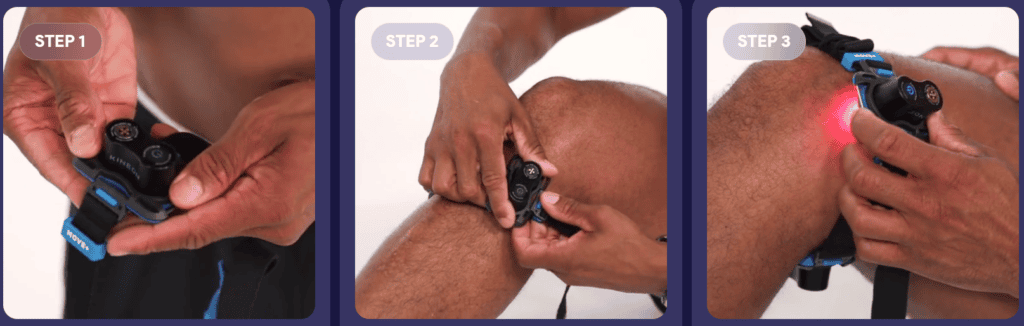
Each module combines eight 660 nm red LEDs with ten 808 nm near-infrared laser diodes.
The laser diodes produce a narrower, more collimated beam than LEDs at the same wavelength, while the red LEDs add broader surface coverage.
That combination works particularly well in a contact device. Because the modules sit directly against the knee, the working distance stays consistent from one session to the next.
You get 660 nm red light for shallower tissue and 808 nm near-infrared light for deeper penetration, without having to keep measuring your distance from a panel or holding a torch in the same position for several minutes.
👉 Check today’s price on the Kineon Move+ Pro
Where to Place the Device: The 8-Point Knee Map for Osteoarthritis
Research protocols usually treat several points around the knee rather than the kneecap alone. The map below gives you eight useful positions for covering the front, inner, outer, and back of the joint.
- Suprapatellar point: About five centimetres above the kneecap, targeting the suprapatellar pouch and distal quadriceps tendon, an area where swelling can collect.
- Medial joint line: Along the inner gap between the femur and tibia, close to the medial meniscus, MCL, and medial synovium.
- Lateral joint line: Along the outer joint line, near the lateral meniscus, LCL, and lateral synovium.
- Infrapatellar region: Just below the kneecap, covering the patellar tendon and infrapatellar fat pad, both of which can be associated with pain at the front of the knee.
- Medial retinaculum: Along the inner edge of the kneecap, where tissues involved in patellar stability and tracking sit.
- Lateral retinaculum: Along the outer edge of the kneecap, another area that can influence patellar movement and tension around the joint.
- Popliteal area: At the back of the knee, covering the posterior capsule and nearby soft tissues, including the upper gastrocnemius.
- Quadriceps tendon: Directly above the patella, which can deserve extra attention when pain or tendon irritation is concentrated there.
You don’t necessarily need to treat all eight points in one session. A broad red light therapy panel may cover several areas at once, while a smaller contact device may need to be repositioned around the knee.
For red light therapy for knee pain, the main goal is to match placement to where symptoms are coming from rather than repeatedly treating the kneecap alone. Covering the front, inner, outer, and, where appropriate, back of the knee gives you a better chance of reaching the tissues involved in your pain.
The Popliteal Point Most People Skip
The back of the knee is easy to overlook, yet it can be a source of stiffness and swelling. Baker’s cysts develop in the popliteal area, and tightness around the posterior capsule can also contribute to discomfort behind the joint.
If your knee pain includes stiffness at the back of the knee or noticeable swelling in the popliteal fossa, treating the front alone won’t expose that area to much light. A panel can reach it, but positioning the knee and holding the right angle can be awkward.
A wearable device can make rear knee coverage easier by keeping the emitters close to the skin while you treat more than one side of the joint. The best red light therapy leg wraps are especially useful for people who want broader coverage without constantly repositioning a panel.
Skin Prep, Bare Contact, and Eye Protection
For the most predictable exposure, use bare skin unless your device instructions say otherwise. Fabric can reduce or change how much light reaches the skin, but transmission varies with wavelength, material, thickness, and weave.
Near-infrared light can pass through some fabrics far more readily than visible red light, so clothing doesn’t reduce every wavelength by the same amount. Follow the manufacturer’s guidance on lotions and oils.
Eye protection is also worth paying attention to, especially with bright, high-output panels. Near-infrared light is invisible, but the visible red LEDs can still be intense at close range.
Use the goggles supplied with your device or purchase red light therapy eye glasses separately if the manufacturer recommends them, and avoid staring directly into the LEDs during treatment.
How Often to Use Red Light Therapy on Your Knee
Knee osteoarthritis studies use different treatment schedules, so there isn’t one frequency that fits every device. Published protocols range from two or three sessions per week to daily treatment, with some short treatment blocks using twice-daily sessions.
- Short treatment schedules: One older trial in people with degenerative knee osteoarthritis used 15-minute sessions twice daily for ten days. A suddenly hot, red, or heavily swollen knee should still be assessed rather than assumed to be a typical osteoarthritis flare.
- Chronic knee osteoarthritis: Research commonly uses repeated sessions over several weeks. Follow your device instructions and track changes in pain, stiffness, walking, and knee function rather than aiming for a fixed eight- or twelve-week course.
- After knee surgery: Photobiomodulation has been studied after procedures such as total knee replacement, including treatment within the first few postoperative days. Use it after surgery only with guidance from your surgeon or physiotherapist.
- Maintenance: Research hasn’t established a standard long-term frequency. Some people reduce weekly sessions after symptoms improve, while others use treatment more often during periods of heavier activity. Stay within the frequency limits listed for your device.
Kineon, for example, recommends 10 to 15 minutes daily with the MOVE+ Pro, with a maximum of two sessions per day.
Panel vs Wrap vs Laser Device for Knee Pain
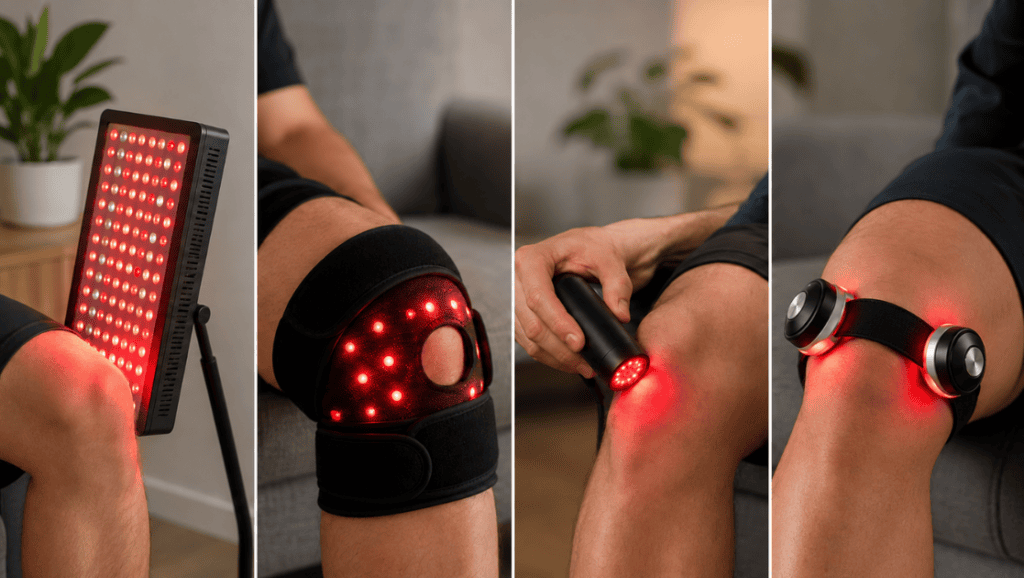
The best device format depends largely on how easily you can position the light around the knee and keep it there for the full session.
- Red light therapy panels cover a broad area and can be angled toward the front, inner, outer, or back of the knee. They can also treat other body areas, but you’ll need enough space and must pay attention to treatment distance because irradiance drops as you move farther away.
- LED wraps and pads strap directly around the knee and run hands-free. Skin contact stays consistent, although coverage depends on the size and shape of the pad. Rotating the wrap can help expose the medial, lateral, and posterior parts of the joint.
- Handheld red light torches give you precise control over where the light lands. They work well for smaller treatment points, but holding a wand in position for several minutes can become tiring.
- Laser contact devices combine direct skin contact with a more focused near-infrared beam. The Kineon Move+ Pro, for example, uses three movable modules that run together. Each module is rated at 160 mW for the red LEDs and 50 mW for its Class 1 laser component, and the strap lets you position the modules around the front, medial, lateral, or posterior knee.
For red light therapy for knee pain, coverage area is only part of the picture. Near-infrared wavelengths, steady skin contact, adequate irradiance, and the ability to treat the front, sides, and back of the knee are better indicators of how well a device suits the joint.
If you’d rather combine light with heat or compression, our guide to knee massagers with red light therapy compares those options.
Combining Red Light Therapy With Knee Rehab, Exercise, and Load Management
Light therapy may reduce pain and stiffness enough to make movement feel easier. That can create a useful window for mobility work, strengthening, or walking without asking the knee to do too much at once.
After a session, try five to ten minutes of gentle movement such as slow knee bends, ankle pumps, or a few sit-to-stand repetitions. The goal is to move the joint through a comfortable range, not to push into fatigue.
If you’re returning to longer walks or strength training, some people use red light therapy before activity or later the same day. Follow your device instructions rather than adding extra sessions beyond the recommended frequency.
If you use NSAIDs or receive corticosteroid or hyaluronic acid injections, keep those treatments on their prescribed schedule and ask your clinician how to fit red light therapy around them.
With red light therapy for knee discomfort, it also helps to address what keeps loading the joint. Excess body weight, reduced hip strength, limited ankle mobility, and rapid increases in activity can all affect knee symptoms even if local pain settles.
Clinical studies often pair photobiomodulation with exercise rather than using light therapy by itself. The light may help with pain and stiffness, while rehab builds strength, movement tolerance, and joint capacity over time.
For another way to combine light with movement-based treatment, see the benefits of red light vibration therapy.
How to Track Results Over 4 to 8 Weeks
Changes in knee pain, stiffness, and walking ability can take several weeks to become noticeable, so judging progress by memory alone can be misleading.
Choose one symptom to track, such as morning stiffness on a 0-to-10 scale or pain while walking downstairs. Pair it with one repeatable function test, such as a timed walk over the same distance or the number of sit-to-stand repetitions you can complete in 30 seconds.
If your numbers haven’t changed after four weeks, review how you’re using red light therapy for knee pain. Check that you’re treating the areas linked with your symptoms, using the recommended distance, and following the frequency listed for your device.
If your technique and device use are consistent but symptoms remain unchanged, it may be worth discussing other causes with a clinician. Knee pain can sometimes originate from the hip, lower back, tendons, or other structures rather than the knee joint itself.
6 Common Mistakes That Can Undercut Red Light Therapy for Knee Pain
- Treating only the front of the knee: Rotate placement around the medial, lateral, and posterior areas when those regions are part of your symptoms.
- Using a panel too far away: Irradiance falls as distance increases, so check the manufacturer’s output figures at the distance you actually use.
- Treating through clothing or thick products: Fabric, compression sleeves, heavy creams, and oils can reduce the amount of light reaching the skin.
- Using sessions inconsistently: Research usually relies on repeated treatment over several weeks, so follow the frequency recommended for your device rather than clustering sessions at random.
- Assuming longer sessions work better: More exposure doesn’t necessarily improve results. Stay within the treatment time and frequency listed by the manufacturer.
- Judging results too early: Track pain, stiffness, and function over several weeks so you can see whether anything is changing rather than relying on how the knee feels after a few sessions.
Who Should Check With a Doctor Before Using Red Light Therapy on the Knee
Red light therapy is generally well tolerated, but some situations call for medical guidance before treating the knee.
- Active infection or a healing surgical wound: Get medical guidance before treating the area directly and follow the instructions for your device.
- Knee replacements or internal hardware: Ask your surgeon or physiotherapist before treating over a joint replacement, ACL screws, plates, or other implanted hardware.
- Photosensitising medications: Some antibiotics and other medicines can increase sensitivity to light, so check the medication label or ask your pharmacist before starting.
- Cancer in or near the treatment area: Speak with your oncology team before applying photobiomodulation over tissue affected by active cancer or a previous tumour site.
- Pregnancy: Research on photobiomodulation during pregnancy is limited, so medical guidance is sensible before use.
These situations don’t always rule out red light therapy, but they can change where, when, or how it should be used. A clinician who knows your medical history can give more specific guidance.
The Bottom Line on Using Red Light Therapy for Knee Pain
Using red light therapy for knee pain comes down to three things: delivering an appropriate dose, treating more than just the front of the knee, and following a consistent schedule over several weeks.
Device output affects all three. A low-irradiance device may take much longer to deliver the same surface dose, while a fixed-distance panel can make it harder to reach the medial, lateral, and posterior parts of the joint without repositioning.
Before your next session, check the irradiance rating at the distance you actually use and confirm whether the device includes near-infrared wavelengths as well as visible red light.
If you prefer direct contact and adjustable placement around the knee, the Kineon Move+ Pro combines red LEDs with near-infrared laser diodes in three movable modules.
Frequently Asked Questions
Does Red Light Therapy Work for Knee Arthritis?
Research suggests red light therapy can reduce pain and improve function in some people with knee osteoarthritis. Results depend on wavelength, dose, treatment frequency, and the device used. Near-infrared wavelengths are among the most extensively studied for knee osteoarthritis, particularly in the 785 to 905 nm range.
How Long Does It Take To See Results From Red Light Therapy On Knees?
Some people may notice changes in pain or stiffness within a few weeks. Many knee osteoarthritis studies measure outcomes after roughly three to eight weeks of repeated treatment, so a couple of sessions usually isn’t enough to judge the response.
Can I Use Red Light Therapy On The Back Of My Knee?
Yes, if your device instructions permit treatment behind the knee. Reaching the posterior knee can expose tissues that receive little light during front-only sessions.
Unexplained swelling behind the knee, especially a new lump or suspected Baker’s cyst, should be assessed before treating the area. Avoid placing the device over an open or unhealed wound.
What Wavelength Is Best For Knee Pain?
Near-infrared wavelengths around 808 to 850 nm are well represented in knee osteoarthritis research because they penetrate deeper than visible red light. Studies have also used wavelengths around 785 to 860 nm and 904 to 905 nm.
Many home devices pair near-infrared light with 660 nm red light to cover both deeper and more superficial tissues around the knee.
How Close Should I Hold A Red Light Panel To My Knee?
Use the distance listed by the manufacturer. Panel output can change sharply between 6, 12, and 18 inches, so there isn’t one correct distance for every device.
Check the irradiance measured at your working distance and match your session time to the device instructions.
Can Red Light Therapy Help Meniscus Tears?
Red light therapy may help reduce pain associated with a meniscus injury, but there’s no good evidence that it can repair a torn meniscus.
For a confirmed meniscus tear, photobiomodulation is better viewed as a possible addition to rehabilitation, strength work, and load management rather than a replacement for them.
Is Red Light Therapy Safe For Knees After Surgery?
Photobiomodulation has been studied after procedures including total knee replacement, with some research reporting reductions in swelling and improvements in early function.
Timing depends on the operation and stage of healing. Get clearance from your surgeon or physiotherapist before treating a recently operated knee, and don’t place a device over an open or unhealed incision unless your surgical team has specifically approved it.
Health Disclaimer: This article is for informational purposes only and is not medical advice. Red light therapy may not be suitable for everyone, and results can vary. Talk with a qualified healthcare professional before using it for knee pain, especially after surgery, during pregnancy, or if you have an underlying medical condition or take photosensitizing medication. Do not use it as a substitute for diagnosis or treatment from a medical professional.