Red light Therapy for Crepey Arms: Support Firmer-Looking Skin Without Harsh Treatments
Summer has a way of putting arms back on display. Sleeveless tops, sundresses, swimsuits, and vacation photos all draw more attention to the upper arms than they got all winter. For many women, that’s also when crepey texture, loose-looking skin, and loss of firmness become harder to ignore.
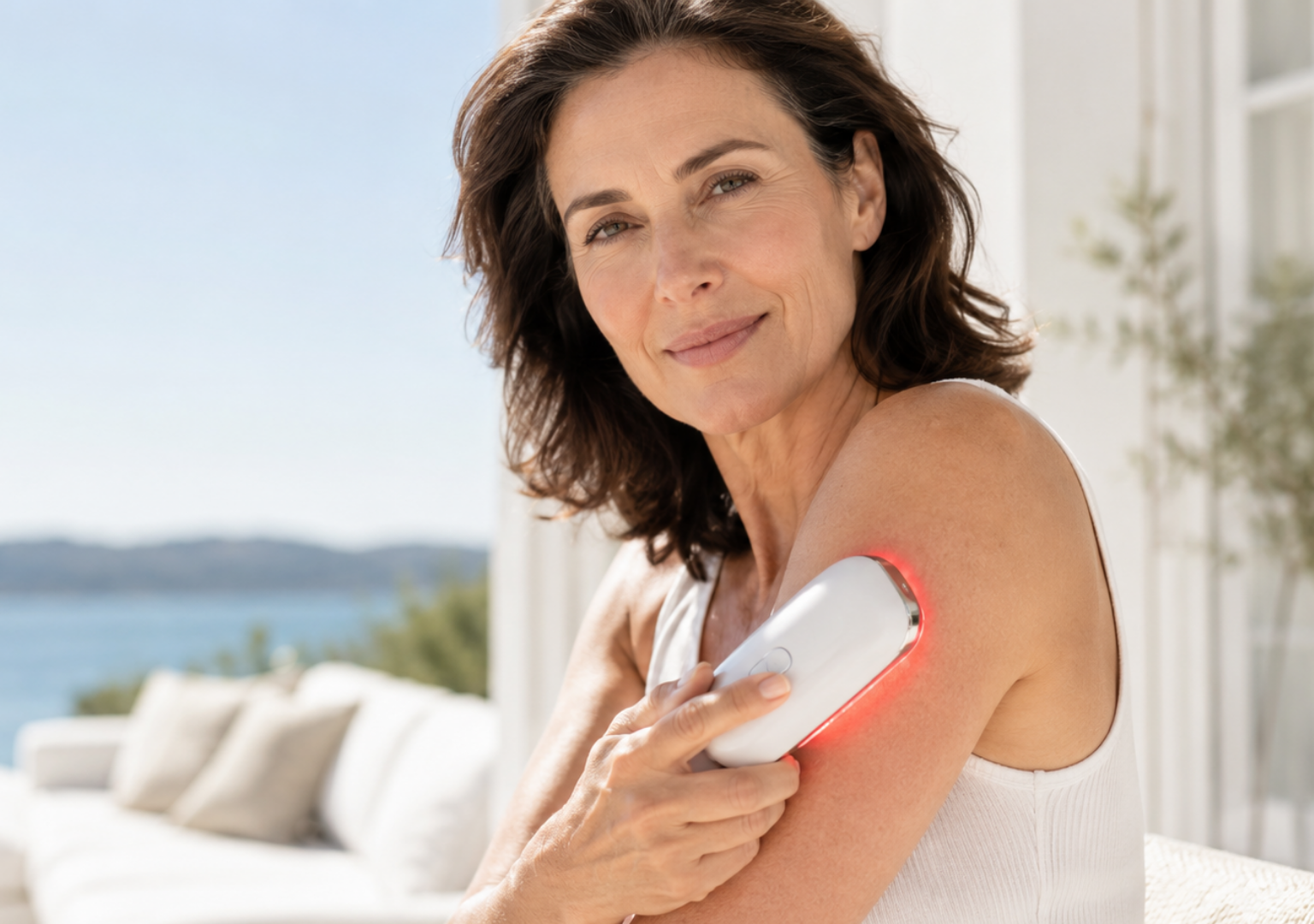
Red light therapy for crepey arms is one at-home option people turn to when moisturizers and firming creams make skin feel softer but don’t do enough for the way their arms look.
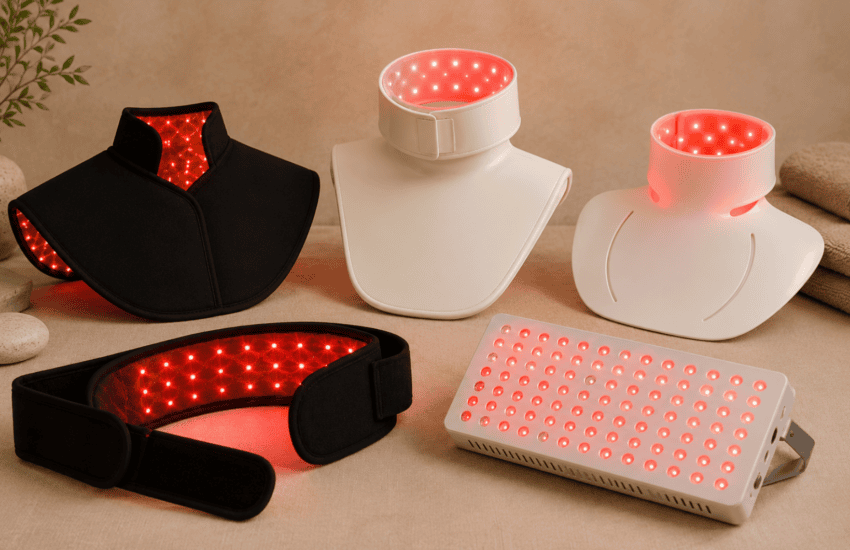
For upper arms, there are a few options available. A flexible red light wrap hugs the area for targeted sessions. A larger red light panel covers the arms along with the neck, chest, and body, while a handheld device like MyoGlow gives you more control around the upper arms, elbows, and smaller areas where you want a little extra attention.
To help you choose with confidence, this guide compares red light therapy wraps, panels, and handheld devices by coverage, comfort, treatment time, and fit for upper-arm care.
| Product | Format | Wavelengths | Best For | Where to Buy |
|---|---|---|---|---|
| MyoGlow Sculpt & Firm Device | 4-in-1 sculpting device | Red, blue, amber LED with warmth | Multi-mode arm sculpting and firming | Check Price on MyoGlow |
| Glokore Red Light Therapy Wrap | Flexible arm wrap | 660nm + 850nm | Wider pad for even upper-arm coverage | Check Price on Glokore |
| Novaa Light Pad | Wearable light pad | 660nm + 850nm | Higher LED density | Check Price on NovaaLab |
| Mito Red MitoPRO 750X | Multi-wavelength panel | 590, 630, 660, 810, 830, 850nm | Upper-body panel coverage | Check Price on Mito Red Light |
| Lifepro BioHeal Plus | Full-body LED panel | 660nm + 850nm | Versatile panel for arms and body | Check Price on Lifepro |
| Hooga PRO300 | Compact dual-chip panel | 660nm + 850nm | Targeted arm panel sessions | Check Price on Hooga |
How Red Light Therapy Works for Crepey Arms
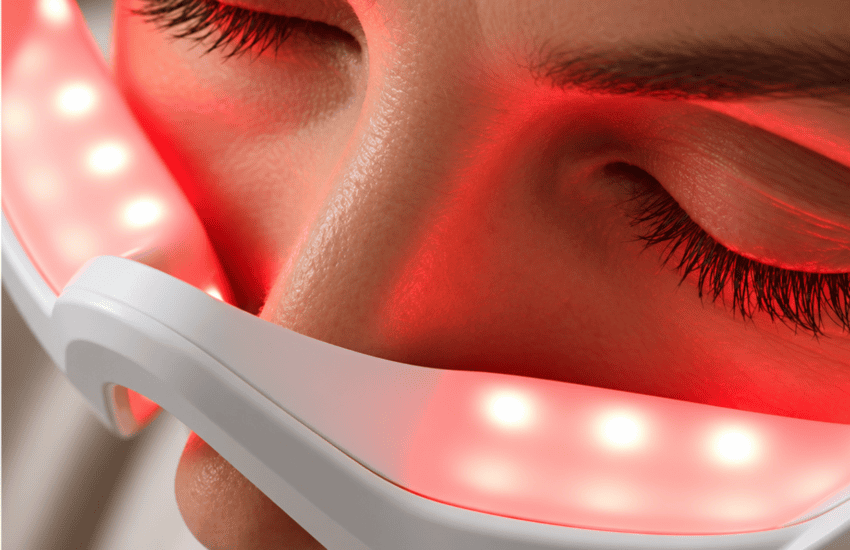
Red and near-infrared light are used in photobiomodulation, where light exposure may support cellular energy and skin-cell signaling. For crepey-looking arms, the goal is gradual support for collagen-related firmness, elasticity, and smoother-looking texture rather than an instant tightening effect.
For crepey upper arms, home red light therapy devices usually come down to a few specific details:
- Red and near-infrared wavelengths, commonly around 660nm and 850nm, which sit near the red/NIR ranges studied for skin texture, elasticity, and visible signs of aging
- A design that fits the upper arms, such as a hand-held device for targeted areas, a panel for broader coverage, or a wrap for closer contact
- Short session times, often around 10 to 20 minutes per area
- Adjustable straps or stands, which make it easier to position the light around the upper arms
Rather than a one-time fix, red light therapy for skin works through repeated use over several weeks or months. When used a few times a week, changes in arm texture and firmness tend to show up gradually rather than overnight.
Editor’s Top Pick – MyoGlow Sculpt & Firm Device
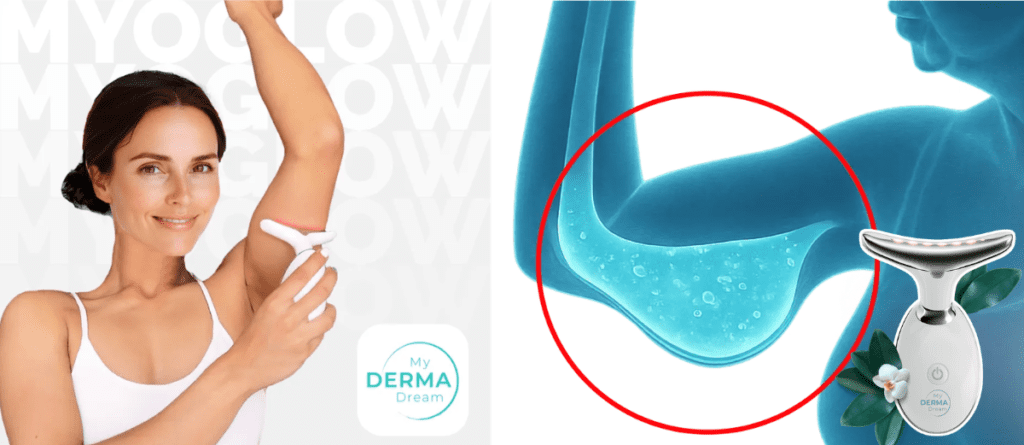
The MyoGlow Sculpt & Firm Device is made for crepey-looking upper arms that body lotions can soften but may not visibly firm on their own. Instead of relying on one feature, it combines red, blue, and amber LED modes with warmth, sonic massage, electroporation, and a paired arm serum for a more complete upper-arm treatment.
- Red light supports firmness, helping to target the look of sagging, aging-related texture, and loss of bounce.
- Blue light is positioned for rough, crepey-looking skin, helping arms look smoother and more refined.
- Amber light helps to minimize puffiness, which can make the upper arms appear more contoured and toned.
To use it, glide the device along the bicep and tricep with the paired arm serum. This gives the electroporation feature the right slip and conductivity while supporting better serum absorption than ordinary topical application alone.
Who MyoGlow Works Best For
The MyoGlow device is a good fit for anyone who has cycled through firming body lotions, retinol creams, and arm wraps without getting the texture change they wanted.
The pairing of LED light, sonic massage, and gentle warmth reaches beyond surface hydration in one session, which fits women dealing with menopausal collagen loss, post-weight-loss laxity, or years of sun-damaged crepe texture on the upper arms.
Who Might Want to Skip It
If your main concern is heavy, hanging skin after major weight loss, no at-home red light device on its own will give you the tightening that surgical options like brachioplasty offer. MyoGlow also works on one arm at a time, and the matching arm serum is part of the routine if you want the absorption feature to work as intended.
Best Red Light Therapy Arm Wraps for Crepey Skin
Wraps and wearable pads are a common starting point for crepey arms because they fasten directly to the upper arm and free your hands during use. The LEDs sit against the skin, which keeps the light close and sessions portable.
2. Best Arm Coverage – Glokore Red Light Therapy Wrap
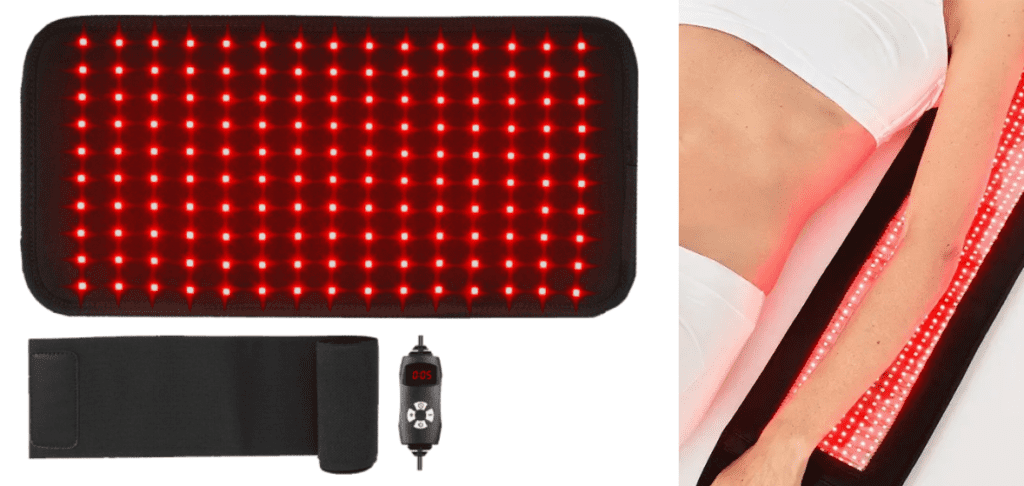
The Glokore Red Light Therapy Wrap is a wide flexible pad with 240 LEDs split evenly between 660nm red light and 850nm near-infrared. You can strap it around the upper arm or lay the pad flat and rest your arm on top, so the LEDs sit against the bicep and tricep without holding anything in place. The broad pad covers the full upper arm in one position.
Who Glokore Works Best For
This is a strong pick for anyone who wants even, full upper-arm coverage without setting up a panel.
You can fasten it around the bicep and tricep for active sessions, or lay the pad flat on the couch and rest your arm on top while reading, working, or watching TV. The wide LED array keeps light steady across the crepey zones, and the rest-on-top option means you don’t have to wrestle with straps every time.
Who Might Want to Skip It
If you want both arms covered at the same time, a standing panel will move faster than swapping the wrap from one side to the other. The Glokore is also built for single-area sessions, so anyone who wants a multi-mode tool with sonic massage or warmth alongside the LEDs may prefer something like the MyoGlow.
3. Best LED Density – Novaa Light Pad
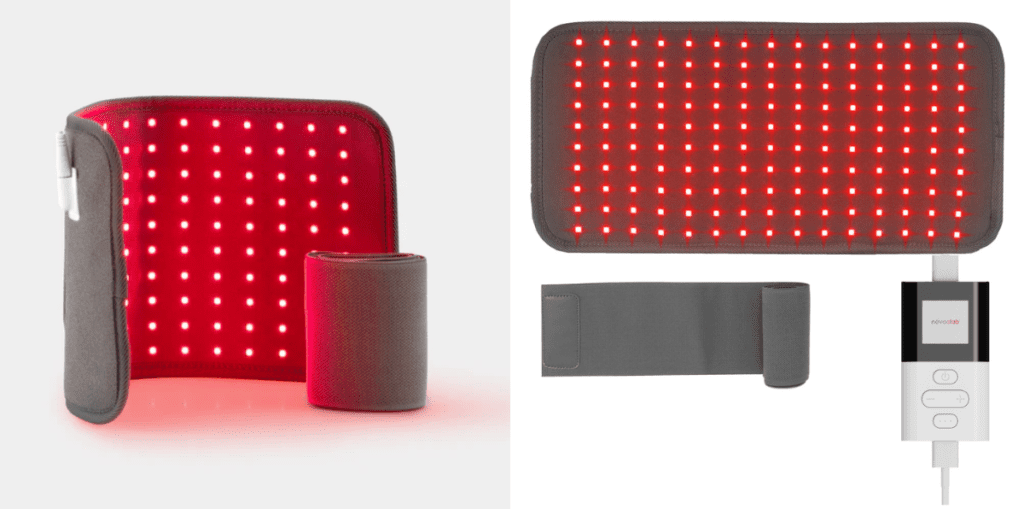
Novaa Light Pad is a flexible pad that wraps around the arm with an included strap. It pairs 660nm red light and 850nm near-infrared LEDs across a wider surface than a small handheld. The pad lies flat or curves, so it adapts to bicep, tricep, and forearm areas, and can move to other body zones as needed.
Who Novaa Light Pad Works Best For
This works well for people who want a single pad to cover larger arm zones and rotate to other body areas like the lower back, knees, or shoulders. It also suits buyers who like a flexible format that wraps comfortably without bulky panels.
Who Might Want to Skip It
The pad covers one zone at a time, so full upper-arm sessions still happen one arm at a time. If you want both arms in the same light window, a standing panel will be faster.
For a wider look at wearable formats, see our guide to the best red light therapy leg wraps, since many flexible pads can also be used across arms, legs, knees, and shoulders.
Best Red Light Panels for Full-Arm and Body Coverage
Panels suit buyers who want one device that handles arms along with face, chest, and other body areas. You stand or sit in front of the panel, and both arms can sit in the light window at the same time.
4. Best Multi-Wavelength Panel – Mito Red MitoPRO 750X
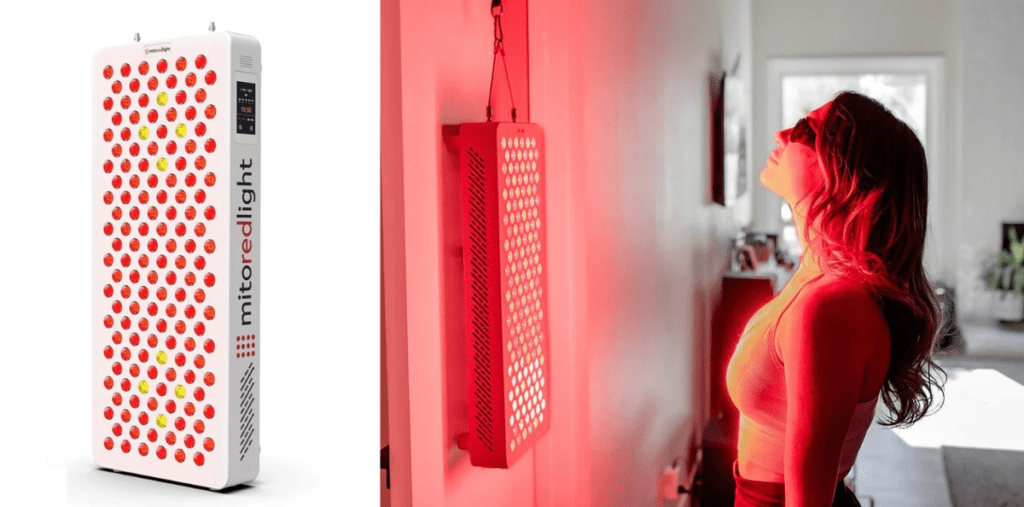
Mito Red MitoPRO 750X is a mid-size red light therapy panel designed for upper or lower body sessions.
It uses six wavelengths, 590nm, 630nm, 660nm, 810nm, 830nm, and 850nm, giving it broader amber, red, and near-infrared coverage than basic two-wavelength panels. For crepey arms, it works best as a hands-free panel option when you want to treat both arms, shoulders, chest, or upper body in the same session.
Who Mito Red MitoPRO 750X Works Best For
The six-wavelength inclusion suits buyers who want a broader panel than a basic 660nm and 850nm device, especially if they also want to use it across the chest, shoulders, back, or legs.
Who Might Want to Skip It
It’s bigger than a wrap and needs floor or wall space, so smaller rooms may feel crowded. The price tier is also higher than entry-level panels, which can be a stretch for first-time buyers.
5. Lifepro BioHeal Plus
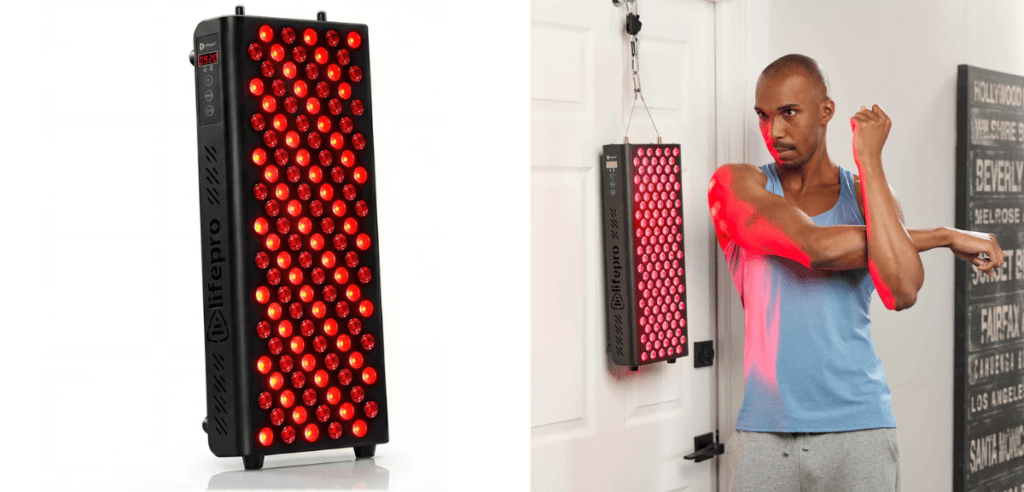
Lifepro BioHeal Plus is a slim panel with 120 LEDs, split between 60 red 660nm LEDs and 60 near-infrared 850nm LEDs. It can be used with a stand, placed flat, or mounted on a door or wall
Three modes (red, near-infrared, or both) and a 10 Hz pulse option let you vary each session to match the routine.
Who Lifepro BioHeal Plus Works Best For
This is a strong fit for people who want a red light panel that covers the upper arm from shoulder to elbow in one go, without claiming floor space. The door-mounted device hangs vertically out of the way, and the pulse mode plus three light settings give buyers who like to mix things up more session options than a single-mode device.
Who Might Want to Skip It
If you want both arms in the light window at the same time, the panel is on the narrow side, so doing both arms means rotating one across after the other. You also need an available door in the room where you want to use it, since the BioHeal Plus is built for door-hanging rather than free-standing.
6. Best Tabletop Panel – Hooga PRO300
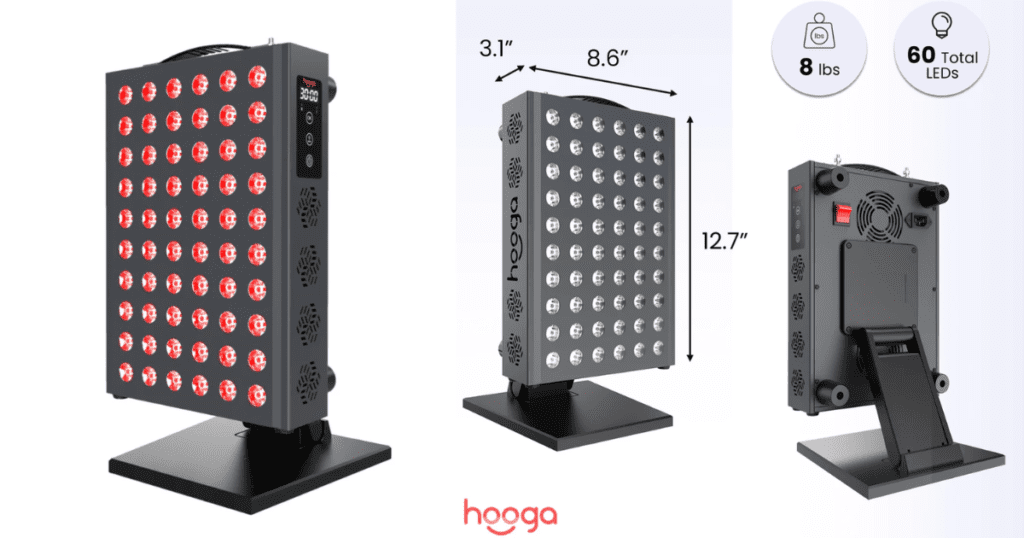
Hooga PRO300 is a compact panel with 60 dual-chip LEDs delivering 660nm red and 850nm near-infrared light. It has a smaller footprint than full-body panels, so it works well for targeted upper-arm sessions on a desk, table, or stand.
Who Hooga PRO300 Works Best For
This works well for people who want a panel but don’t need full-body coverage. The size also suits anyone who prefers to do one arm at a time and add face, neck, or shoulders in the same session.
Who Might Want to Skip It
If you want both arms in the light window at once, a larger panel like the BioHeal Plus or MitoPRO 750X will give wider coverage. The PRO300 is built for focused sessions rather than full-body work.
How to Choose the Best Red Light Therapy for Crepey Arms
The right device for crepey arms depends on wavelengths, coverage style, and your schedule. Before comparing brand names or long feature lists, look at the details that affect arm coverage, comfort, and repeated use.
Wavelengths and Light Spectrum
Wavelengths are worth checking before anything else. For skin, 660nm red light and 850nm near-infrared light are two of the most studied options, and a typical red light therapy device will usually include both.
- 660nm red light works closer to the skin’s surface, where roughness and crepey texture are more visible
- 850nm near-infrared light reaches deeper layers where collagen support becomes more relevant
- Dual-wavelength devices cover both surface texture and deeper skin support in the same session
- Multi-wavelength panels may add 630nm and 830nm for broader light coverage
Format and Coverage
The device format changes how treatment feels in day-to-day use. Wraps and pads stay on the arm without much effort, while panels cover larger areas from a short distance.
- Wraps fasten around the arm for focused treatment on one area
- Pads cover a wider section of the upper arm and can often be used on other body areas
- Panels can treat both arms at once when positioned at the right distance
- Multi-mode devices may add massage, heat, or product absorption features alongside LED light
Session Time and Weekly Use
Red light therapy works gradually, so session length and repeat use carry more weight than a long list of modes. Most home devices call for 10 to 20 minutes per area, a few times per week.
- Wraps and pads stay on the arm during the session, which makes them easier to use while sitting still
- Panels require the arms to stay within the recommended distance for the full treatment window
- Handheld devices work well for targeted areas
- Pairing treatment with another habit, such as listening to a podcast or stretching, can make weekly use easier to maintain
For a deeper schedule breakdown, see our guide on how often you can do red light therapy
Red Light Therapy vs Other Treatments for Crepey Arms
Red light therapy sits between body creams and in-office skin tightening. It offers more skin support than a topical alone, but it is far less invasive than surgery and usually costs less over time than repeated medspa visits.
The right choice depends on how loose the skin is, how much recovery time is realistic, and whether the goal is better texture, firmer-looking skin, or a bigger change in upper-arm shape.
| Approach | How It Works | Downtime | Best Suited For |
|---|---|---|---|
| At-home red light therapy | Uses red and near-infrared LED light to support skin activity | None | Mild to moderate crepey texture and thinning-looking skin |
| In-clinic LED sessions | Uses similar wavelengths with professional guidance | None | People who prefer clinician-led care |
| At-home microneedling | Tiny channels in the skin to support collagen induction | One to two days of redness | Surface texture, fine lines, and early crepiness |
| Radiofrequency or Morpheus8 | Uses heat to support deeper collagen remodeling | A few days of redness or swelling | Moderate laxity that at-home LED may not fully address |
| Brachioplasty | Surgical removal of excess upper-arm skin | Several weeks | Heavy, hanging skin after major weight loss |
| Retinol body creams | Support surface turnover and smoother texture | Possible mild irritation | Mild crepiness, roughness, and uneven tone |
| HRT (for menopausal users) | May support collagen and elastin changes linked to hormone loss | None | Menopausal skin changes under medical guidance |
For earlier crepey arm changes, red light therapy pairs well with a retinol body cream, moisturizer, sunscreen, and strength training. The light supports skin firmness and texture, while retinol and hydration help the surface look smoother.
More advanced laxity usually needs a stronger approach. A panel, wrap, or handheld LED device is unlikely to tighten loose upper-arm skin the way radiofrequency, Morpheus8, or surgery can. Very loose skin after major weight loss often points toward brachioplasty.
For many people, red light therapy is a reasonable first step due to its convenience, lower cost and lower level of commitment.
Tips for Getting the Most from Red Light Therapy on Crepey Arms
Red light therapy works through repeated use, not one rushed session before a sleeveless event. A few small habits can make each treatment more consistent and give the skin a better chance to respond over time.
- Start with clean, dry skin so the light reaches the upper arms without lotion, sunscreen, or body oil getting in the way
- Follow the recommended distance for the device, especially with panels, since sitting too far away can reduce exposure
- Use serum or moisturizer at the right time based on the device instructions. Some devices pair with serum during treatment, while others work better on bare skin first. If you’re unsure what to apply before or after your session, our guide to what serum to use with red light therapy can help.
- Keep sessions to a few times a week rather than treating the same area every day, unless the brand directions say otherwise
- Take progress photos every couple of weeks using the same lighting and arm position, since changes in crepey texture tend to show up slowly
- Protect the eyes around bright panels during longer sessions, especially when the light is close to the face or upper body. See our guide to glasses for red light therapy to compare options.
For crepey upper arms, consistency is usually more useful than chasing the longest session time. The device needs enough repeated exposure to support skin texture and firmness, but the weekly plan should still feel realistic enough to keep using.
The Bottom Line
The best red light therapy for crepey arms should be targeted enough for the upper arms and realistic enough to use more than once. Crepey skin is rarely about texture alone.
Dryness, thinning skin, uneven tone, and loss of firmness usually show up together, so the right device should address more than surface glow.
MyoGlow is our recommendation because it targets the upper arms as their own skincare concern. The handheld shape lets you work directly over the bicep and tricep, where crepey texture and laxity often shows up first.
It also combines red LED light for collagen-related skin support with warmth, sonic massage, and electroporation to help the paired arm serum absorb better than body cream alone.
For anyone comparing red light therapy devices for smoother-looking upper arms, MyoGlow offers one of the more targeted at-home approaches. It won’t replace time, hydration, or sunscreen, but it gives crepey-looking arms a more serious weekly care plan before sleeveless season and beyond.
FAQs: Red Light Therapy for Crepey Arms
Can red light therapy tighten loose skin on arms?
Red light therapy may help improve the appearance of mild laxity, rough texture, and crepey-looking skin by supporting collagen-related skin changes over time. It should not be positioned as a true skin-tightening treatment for heavy loose skin, especially after major weight loss. For a fuller explanation, see our guide on whether red light therapy can tighten skin.
Is red light therapy safe for all skin types?
Red light therapy is generally considered low-risk when used as directed, but it is not ideal for everyone. People with light-sensitive conditions, a history of skin cancer, active skin irritation, or photosensitizing medications should check with a healthcare professional before using an at-home LED device.
What wavelength is best for crepey skin on arms?
Most sources recommend red light in the 630 to 670 nm range for skin concerns. Some devices also include near-infrared around 850 nm, which penetrates deeper and may support collagen at lower skin layers.
A combination of red and near-infrared is common in home devices and offers both surface and deeper benefits.
How long does it take to see results from red light therapy on arms?
Some people notice subtle changes in skin feel or texture within several weeks, but visible changes usually require consistent use over 8 to 12 weeks or longer. Results depend on the device, wavelength, dose, treatment schedule, skin condition, age, sun damage, and whether you keep supporting the skin with hydration and sun protection.
Can I use red light therapy with other skincare products?
Yes, but timing depends on the device. Most panels and wraps are best used on clean, dry skin first, then followed with moisturizer or body serum. Devices designed to work with conductive serum, like MyoGlow, may require product during use, so follow the brand instructions.
Is red light therapy better than retinol or other creams for crepey arms?
Red light therapy and topical products like retinol work through different mechanisms and can be used together. Retinol supports cell turnover and collagen production at the skin’s surface, while red light penetrates deeper to stimulate cellular activity.
Combining both approaches may give better results than using either alone, and many dermatologists recommend pairing light therapy with a solid skincare routine.
Can I use red light therapy every day on my arms?
Many devices are safe for daily use, but three to five sessions per week is usually sufficient for skin concerns. Overuse does not speed up results and may cause mild irritation in some people.
Follow the manufacturer’s guidelines for your specific device, and start with shorter, less frequent sessions if you have sensitive skin. More is not always better, and excessive use could potentially irritate your skin.
Are there any side effects from using red light therapy on arms?
Red light therapy is generally safe when used as directed. The most common side effects are mild redness, warmth, or temporary irritation, which usually decide quickly. People taking photosensitizing medications or those with certain skin conditions should consult a doctor before starting.
Eye protection is also recommended if your device emits bright light.
Do I need an FDA-cleared device for crepey arms?
FDA clearance is not mandatory for every cosmetic red light device, but it can be a useful trust signal. It means the device has gone through a regulatory review for a specific intended use. If a brand claims FDA clearance, check that the claim applies to the actual device and use case, not just the company or a different product.
Disclaimer: This article is for general skincare education only and is not medical advice. Red light therapy results vary by person, skin condition, device quality, and consistency of use. Always follow the manufacturer’s directions, avoid using LED devices over irritated or broken skin, and speak with a licensed healthcare professional before use if you are pregnant, have a medical condition, take photosensitizing medication, or have a history of skin cancer. Product claims should not replace diagnosis or treatment from a qualified provider.