Red Light Therapy for Eczema at Home: What You Need to Know
Living with eczema can feel like an ongoing cycle of itchy flare-ups, short-term relief, and products that don’t always deliver the results you hoped for. Red light therapy is now gaining attention as a gentle, noninvasive option that may complement an existing eczema care plan.
In this guide, I’ll explain what current research suggests about using red light therapy for eczema at home, what results you can realistically expect, and how to choose a device that fits your needs.
What Is Red Light Therapy and How Does It Work for Eczema?
Red light therapy uses visible red wavelengths, commonly around 630–670 nm, that penetrate below the skin’s surface. Early research suggests this light may support skin repair by influencing cellular energy production and inflammatory signaling.
At the cellular level, red light is thought to interact with the mitochondria, which produce ATP, the energy cells use to function. This process may affect inflammation and tissue repair, making photobiomodulation an area of interest for skin conditions involving irritation or a weakened skin barrier.
Research specifically examining red light therapy for eczema is still limited, and much of the current evidence comes from laboratory, wound-healing, and broader dermatology studies. These findings help explain how the therapy may work, but they do not yet establish it as a proven eczema treatment.
Red light therapy is therefore best viewed as a complementary option rather than a replacement for moisturizers, prescribed medication, or dermatologist-directed care.
Choosing a device with clearly stated wavelengths, irradiance, treatment distance, and safety guidance can make it easier to use consistently and follow the manufacturer’s recommended protocol.
Considering Red Light Therapy for Eczema at Home
At-home red light therapy devices are becoming more common among people looking for an easy way to support their skin alongside their usual eczema care. Their main advantage is convenience, since they can be used regularly at home without adding another topical product.
Research into photobiomodulation suggests that red light may influence inflammatory signaling, cellular energy production, and the skin’s natural recovery processes.
While it’s not yet a widely recommended treatment for eczema, ongoing studies are exploring how these mechanisms might support skin barrier health over time.
For people interested in trying it as a complementary option, the appeal lies in its gentle, low-effort approach. At-home devices are not FDA-cleared specifically to treat eczema, so they should not replace moisturizers, prescribed medication, or dermatologist-directed care.
Choosing the right device is still important, particularly because wavelength, irradiance, treatment distance, and safety guidance can vary considerably between models.
Choosing the Right Red Light Therapy Device for Home Use
Shopping for LED red light panels for skin conditions can feel like navigating a maze of specs and claims.
A few specifications matter more than the rest.
- Wavelengths: Most home photobiomodulation devices use red light around 630–670 nm, near-infrared light around 810–850 nm, or a combination of both. Research has not yet established an ideal wavelength specifically for eczema.
- Power density: Look for a manufacturer that states the irradiance at a specific treatment distance. Higher output is not always better, since the total dose also depends on how far you sit from the device and how long each session lasts.
Device size is another important consideration. A handheld model works well for smaller areas such as the inner elbows, behind the knees, or isolated facial patches.
A solid entry-level option is the Lifepro Handheld Red Light Therapy Device, which delivers both red and near-infrared wavelengths in a compact, easy-to-use format.
For larger areas across the back, arms, or legs, a panel can reduce the need to reposition the device as often and provide broader, more even coverage.
In that case, a model like the Lifepro BioHeal Plus Red Light Therapy Panel is one option worth considering for people who want to treat several areas more efficiently at home.
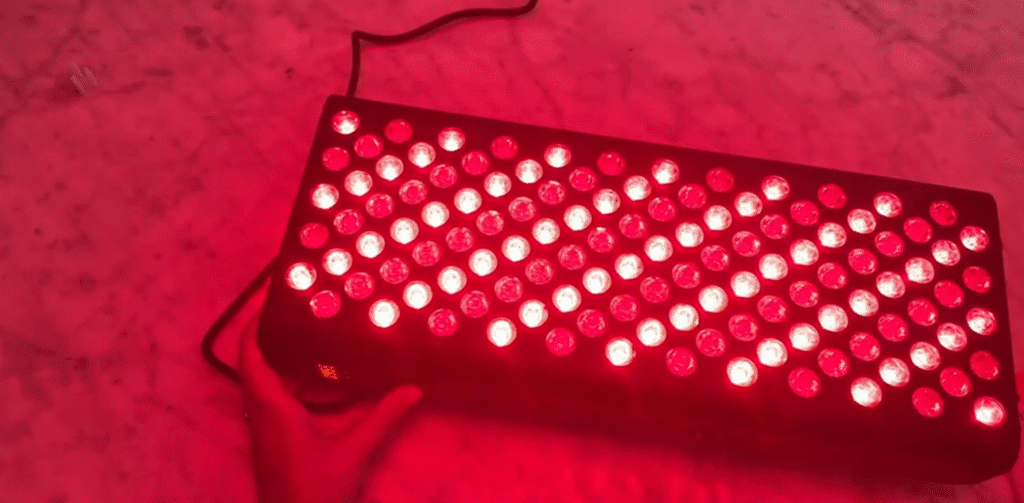
The Lifepro Red Light Therapy Panel combines red and near-infrared wavelengths in a larger format than a handheld device. Its broader treatment area makes it more convenient for covering sections of the back, arms, or legs with fewer repositionings.
Lower-priced devices in the $100–$300 range are often compact and better suited to smaller areas. Panels costing $500 or more generally provide broader coverage and additional controls, although price alone does not determine treatment quality.
Before choosing a device, check for clearly stated wavelengths, irradiance at a specific distance, safety instructions, and recognized electrical certifications. Where a brand claims FDA clearance, confirm the exact device and intended use, since clearance for one purpose does not mean it has been approved to treat eczema.
How to Use Red Light Therapy for Eczema: Step-by-Step Guide
Getting started with your red light therapy session duration is simpler than you might think.
- Position yourself 6-12 inches from your device (check your manual—each model varies slightly).
- Start with just 3-5 minutes per area, especially if you’re new to it.
- Gradually work up to 10-15 minutes as you see how your skin responds.
Begin with the shortest session recommended by your device manufacturer and monitor how your skin responds before increasing the treatment time. There is no standardized at-home red light schedule for eczema, so avoid exceeding the device instructions.
Combining Red Light with Other Eczema Management Strategies
Red light therapy may work best as part of a broader skincare routine. For example, using moisturizer after your session (not before) helps avoid blocking the light’s penetration.
Follow the device instructions regarding clean skin and product application. Continue using moisturizers and prescribed treatments as directed, and ask your healthcare provider how to time them around red light sessions.
Always check in with your healthcare provider with any concerns.
Safety Considerations and Potential Side Effects
Red light therapy is generally well tolerated, but a few precautions are worth noting.
If you’re pregnant, taking photosensitizing medications, or have light-sensitive skin conditions, speak with a healthcare provider first.
During use, mild warmth is normal (a bit like sunshine). But if you experience redness or irritation, shorten your session or increase the distance. Always wear the safety goggles provided to protect your eyes.
Stick to recommended times since treating the same area repeatedly won’t speed results and may do more harm than good. Consistency and moderation matter more than intensity.
Conclusion
Red light therapy is a promising, noninvasive option for people interested in adding a light-based device to their eczema care routine. Early research suggests that photobiomodulation may influence inflammation, cellular energy production, and skin-barrier repair, although direct clinical evidence for eczema remains limited.
The Lifepro Handheld Device offers convenient coverage for smaller patches, while the Lifepro Red Light Therapy Panel can treat larger areas more efficiently. Neither device should replace moisturizers, prescribed medication, or dermatologist-directed care, but both offer an accessible way to explore red and near-infrared light at home.
Start conservatively, follow the device instructions, and track how your skin responds. Stop using the device if it increases redness, discomfort, or irritation.
References
- Hamblin, M. R. (2018). Mechanisms and Mitochondrial Redox Signaling in Photobiomodulation. Photochemistry and Photobiology, 94(2), 199-212. PMC5844808. https://pmc.ncbi.nlm.nih.gov/articles/PMC5844808/
- Hamblin, M. R. (2017). Proposed Mechanisms of Photobiomodulation or Low-Level Light Therapy. IEEE Journal of Selected Topics in Quantum Electronics, 23(3), 7000417. PMC5215870. https://pmc.ncbi.nlm.nih.gov/articles/PMC5215870/
- Abe, Y., Konno, H., Yoshida, S., Yamauchi, T., Yamasaki, K., Denda, M., et al. (2019). Red light-promoted skin barrier recovery: Spatiotemporal evaluation by transepidermal potential. PLOS ONE, 14(7), e0219198. https://pmc.ncbi.nlm.nih.gov/articles/PMC6620005/
Disclaimer: This article is for informational purposes only and does not constitute medical advice. Red light therapy is not intended to diagnose, treat, cure, or prevent any disease. Always consult with a qualified healthcare professional before beginning any new treatment, especially if you have a chronic skin condition, are pregnant, or are taking medications that may increase sensitivity to light. Individual results may vary.