Is Red Light Therapy Good for Hyperpigmentation?
Dark spots are frustratingly good at sticking around. A breakout can clear in a week, only to leave behind a brown mark that lingers for months. Melasma can be even trickier, fading, returning, and changing with sun exposure, hormones, and heat.
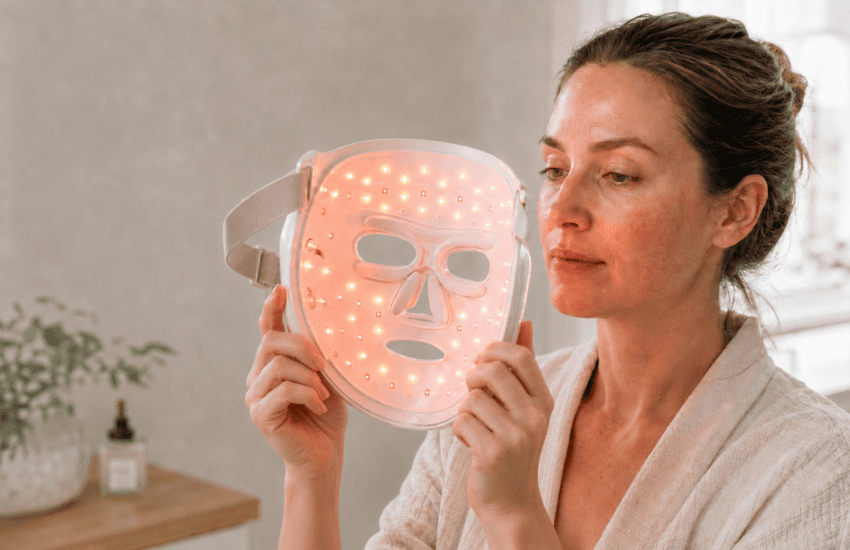
So it’s not surprising that red light therapy for hyperpigmentation has started getting attention. LED masks are already used for everything from fine lines to redness, and early research suggests certain red and near-infrared wavelengths may also affect the way skin produces pigment.
But there’s an important caveat: not all hyperpigmentation behaves the same way, and red light isn’t a guaranteed fix for dark spots.
The best evidence so far is around melasma and the biological pathways involved in melanin production. There’s far less research on post-acne marks, post-inflammatory hyperpigmentation, sun spots, and age spots.
The short version:Red light therapy may help with some types of pigmentation, but the results can depend on the wavelength, dose, skin tone, and what’s causing the discoloration.
So, Can Red Light Therapy Actually Help Hyperpigmentation?
Possibly, but it helps to know what you’re dealing with first.
Hyperpigmentation simply means an area of skin has more pigment than the skin around it. It can include several different types of pigmentation concerns.
- Post-inflammatory hyperpigmentation (PIH) is the flat brown or gray mark that can appear after acne, eczema, irritation, picking, or another type of inflammation.
- Melasma tends to show up as larger patches of pigmentation, often across the cheeks, forehead, nose, or upper lip.
Then there are sun spots and age spots, also known as solar lentigines, which develop after years of UV exposure.
They may all look like “dark spots,” but they don’t have the same cause, and that changes how useful red light therapy is likely to be.
Most of the direct human research has focused on melasma.
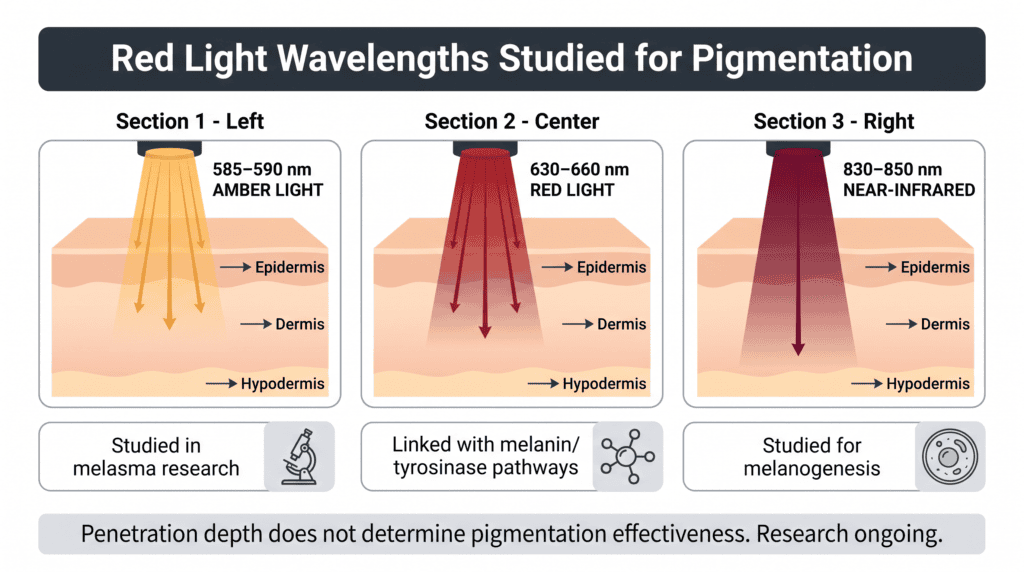
A 2024 review of photobiomodulation for melasma analyzed nine published studies using wavelengths including 630 nm red light, 585 to 590 nm amber light, and 830 to 850 nm near-infrared light. Several reported improvements in pigmentation, but the research was still too limited to establish a standard treatment.
That’s promising, but it’s a long way from saying an LED mask will erase every dark mark on your face.
How Red Light Therapy May Influence Melanin Production
The interesting part is what happens at a cellular level.
Red light therapy, also called photobiomodulation, uses specific wavelengths of light to influence cellular activity. When it comes to pigmentation, researchers are particularly interested in melanocytes, the cells that make melanin.
Melanin production is partly controlled by an enzyme called tyrosinase and a transcription factor known as MITF. Both play a role in melanogenesis, the process that creates pigment.
A study looking at 660 nm red LED light found lower melanin production along with reduced tyrosinase and MITF activity in laboratory and animal models of UV-induced pigmentation.
Near-infrared light is also getting attention. In a 2024 study of 830 nm LED light, researchers found reductions in melanin content, tyrosinase activity, and several proteins involved in pigment production.
That gives researchers a plausible reason why red and near-infrared light could affect uneven skin tone.
What it doesn’t prove is that every device using 660 nm or 830 nm will produce the same result.
With LED therapy, wavelength is only part of the story. Irradiance, treatment time, distance from the skin, and total dose all affect how much light reaches the skin.
If the numbers on a device spec sheet start to blur together, our guide to red light therapy wavelengths breaks down the differences between 630 nm, 660 nm, 830 nm, and 850 nm.
Where the Evidence Looks Most Promising
If there’s one type of pigmentation where red light therapy has earned a closer look, it’s melasma.
One study followed 60 women with melasma and Fitzpatrick skin types V and VI who received 633 nm red light and 830 nm near-infrared light. Researchers reported improvements in melasma intensity and pigmentation.
The treatment schedule was more involved than a typical at-home LED regimen. Participants received treatments over 12 weeks, followed by monthly sessions for another six months, and the study didn’t include a control group.
So while the result is interesting, it shouldn’t be read as proof that a 10-minute LED mask session will produce the same effect.
Amber light has also been studied. One small study using 585 nm LED light reported an improvement in melasma after eight weekly treatments.
But the results haven’t been universally positive. A 2025 randomized pilot trial of 590 nm amber light did not find a significant improvement in its main melasma measures.
That leaves us with a familiar beauty-tech conclusion: there’s enough evidence to keep watching, but not enough to call it settled.
What About Acne Marks and PIH?
This is where the evidence gets thinner.
Red light is often discussed alongside acne because of its effects on inflammation, but calming an active breakout and fading the dark mark it leaves behind are two different things.
There isn’t much direct human research showing that red light therapy fades established post-inflammatory hyperpigmentation.
If you’re dealing with active acne as well as pigmentation, some LED face masks for acne combine red and blue light. Just keep in mind that shorter visible wavelengths may need a bit more caution if your skin is prone to pigmentation.
And if the mark left behind by a breakout is flat and brown rather than indented, it’s usually PIH rather than a true acne scar.
What About Red Light Therapy for Sun Spots?
There’s even less evidence for using red light therapy to remove sun spots, age spots, or solar lentigines.
Red light has been studied more convincingly for broader signs of photoaging, including fine lines, skin texture, and collagen-related changes.
Your complexion may look smoother or more even even if an individual sun spot doesn’t fully fade.
Can Red Light Therapy Make Hyperpigmentation Worse?
This is the part worth paying attention to.
Red light is often marketed as gentle, but skin still responds to dose.
In controlled dose-escalation research, high-fluence red LED exposure caused temporary hyperpigmentation more often on treated skin than untreated skin. Darker skin tones appeared more susceptible.
Those doses were higher than what many consumer LED masks deliver, so there’s no need to panic if you already use one.
But it does show why longer sessions or higher intensity shouldn’t be assumed to fade dark spots faster.
The American Academy of Dermatology also notes that people with darker skin tones may be more prone to visible-light-induced hyperpigmentation.
Melasma deserves extra care too, since it can be triggered by sun exposure and visible light.
If you notice your pigmentation becoming darker after starting LED therapy, don’t simply increase the treatment time and hope it turns around.
How to Use Red Light Therapy for Dark Spots
There’s no universal “10 minutes from six inches away” rule.
An LED mask sitting directly on the face can deliver a very different dose from a panel positioned several inches away, even when both use the same wavelength.
Follow the treatment time and distance recommended for your device.
Most facial LED devices are designed for use on clean, dry skin. If you use retinoids, exfoliating acids, vitamin C, niacinamide, or other pigmentation-focused ingredients, check whether your device recommends applying them before or after treatment.
Our guide to what serum to use with red light therapy covers that in more detail.
And no matter how impressive your LED mask looks on the bathroom counter, sunscreen still does more of the heavy lifting when it comes to preventing new pigmentation.
UV exposure is a major trigger for melanin production, while visible light can also worsen melasma and PIH in some skin tones.
For pigmentation-prone skin, a tinted sunscreen containing iron oxides can offer extra protection against visible light.
There’s also no reliable four-week countdown for results.
The studies available so far use very different wavelengths, doses, schedules, and devices. If you’re testing red light therapy for uneven skin tone, progress photos taken every few weeks in the same lighting will tell you far more than checking the mirror every morning.
Is Red Light Therapy Worth Trying for Hyperpigmentation?
Red light therapy has enough science behind it to be interesting, particularly when it comes to melanin production, melanogenesis, and melasma.
Research involving 660 nm red light and 830 to 850 nm near-infrared light suggests these wavelengths can influence some of the processes involved in pigment production.
But the evidence is still much stronger for the mechanism than it is for real-world results.
If you already use red light therapy for fine lines, skin texture, or general skin rejuvenation, pigmentation may be another change worth keeping an eye on.
If fading dark spots is your main goal, though, red light therapy is better viewed as an extra rather than the centerpiece of your skin-care plan.
Daily sun protection, identifying what type of pigmentation you have, and using treatments that target its cause should still come first.
Frequently Asked Questions
Does Red Light Therapy Fade Dark Spots?
Red light therapy may influence the processes involved in melanin production, and some small studies have reported improvements in pigmentation. There isn’t enough evidence yet to say it reliably fades every type of dark spot.
What Is the Best Red Light Wavelength for Hyperpigmentation?
There is no proven best wavelength. Research has looked at 630 to 660 nm red light and 830 to 850 nm near-infrared light, while 585 to 590 nm amber light has also been studied for melasma.
Does Red Light Therapy Help Melasma?
Some small studies have reported improvements in melasma using red, near-infrared, and amber wavelengths. The research is still limited, however, and there is no established at-home treatment protocol.
Does Red Light Therapy Help Post-Inflammatory Hyperpigmentation?
There isn’t enough direct human research to show that red light reliably fades established PIH. It may still be useful for inflammation while acne or irritation is active.
Can Red Light Therapy Make Dark Spots Worse?
Yes. High doses of red LED light have caused temporary hyperpigmentation in research, particularly in darker skin tones. That’s one reason to follow the treatment time and intensity recommended for your device.
Is Red Light Therapy Safe for Darker Skin Tones?
It can be, but darker skin is more susceptible to visible-light-induced pigmentation. If you have melasma or frequently develop PIH, it’s worth being more cautious with dose and discussing at-home LED therapy with a dermatologist.
Health disclaimer: This article is for general informational purposes only and is not a substitute for medical advice, diagnosis, or treatment. If you have melasma, persistent or changing pigmentation, a photosensitive condition, or take medication that increases light sensitivity, speak with a dermatologist or healthcare professional before using red light therapy.