Best Red Light Therapy Devices for Weight Loss & Belly Contouring at Home
If diet and regular movement have helped but your lower belly, waist, or thighs still aren’t changing as much as you’d like, red light therapy offers a non-invasive way to target those areas at home.
Research into red light and low-level light therapy has reported modest reductions in waist, hip, and thigh circumference, which has helped push the technology into the growing body-contouring market.
For this guide, I compared six red light therapy devices based on wavelengths, treatment area, light output, comfort, and ease of regular use.
The Nushape LipoWrap takes the top spot with its large wraparound treatment area and 635nm red light, a wavelength that has also been studied in body-contouring research.
If you want to understand the science behind it first, read my guide to how red light therapy works for belly fat.
Top 6 Red Light Therapy Devices for Weight Loss at a Glance
| Device | Type | Best For | Price | Wavelengths | Where to Buy |
|---|---|---|---|---|---|
| Nushape LipoWrap | Lipo wrap | Best overall for belly, hips & thighs | $$$ | 635nm + 850nm | Check Price on Nushape |
| MitoQUAD™ Belt | Belt | Medical-grade targeted treatment | $$$ | 630nm, 660nm, 810nm, 850nm | Check Price on Mito Red Light |
| Novaa Light Pad | Flexible pad | Flexible pad for stomach & hips | $$ | 660nm + 850nm | Check Price on Novaalab |
| Glokore Wrap | Wrap | Best value for belly & thighs | $$ | 660nm + 850nm | Check Price on Glokore |
| Lifepro AllevaRed Pro | Belt with vibration | Hands-free waist sessions with added vibration | $$ | 660nm + 850nm | Check Price at Lifepro |
| MitoADAPT MID 4.0 + MAX 4.0 | Panel array | Full-body coverage & customization | $$$$ | 8 wavelengths (590–940nm) | Check Price on Mito Red Light |
What to Look for in a Red Light Therapy Device for Weight Loss
When shopping for a red light therapy device for fat reduction, consider:
- Wavelengths: Look for devices with a combination of 660nm (red) and 850nm (near-infrared) light for optimal tissue penetration.
- Irradiance (power): Look for brands that publish irradiance/fluence at a stated distance, and follow the manufacturer’s protocol. More power isn’t automatically better.
- Coverage area: Panels offer full-body exposure; belts and wraps are more localized.
- Portability: Belts and wraps are ideal for multitasking.
- Ease of use: Built-in timers, comfortable straps, and presets make a difference.
- Warranty and build quality: Devices that include warranties often reflect more reliable engineering.
Once you know what to look for, it’s easier to match a device to your space, goals, and daily routine. Below are our top recommendations for at-home red light therapy devices for fat loss support and body sculpting.
Red Light Therapy Belts, Wraps and Pads for Belly and Waist Contouring
1. Best Overall Red Light Lipo Wrap for Belly, Hips and Thighs – Nushape LipoWrap
Pros
- 635nm + 850nm, the wavelength pairing used in body-contouring research
- 600 LEDs on a 5″ x 20″ panel covers the whole midsection at once
- 51″ neoprene wrap with extenders fits larger waists and thighs
- LED array zips out so the wrap can be washed
- Nushape also markets it for cellulite appearance, workout recovery and skin firmness
- 30-day money-back guarantee, one size fits all
- Rated 5/5 across 1,350+ customer reviews on Nushape’s site
Cons
- Premium price for a wrap
- Power bank for cordless use is sold separately
- 30-day return window
- Results depend on diet, movement and following the brand’s protocol
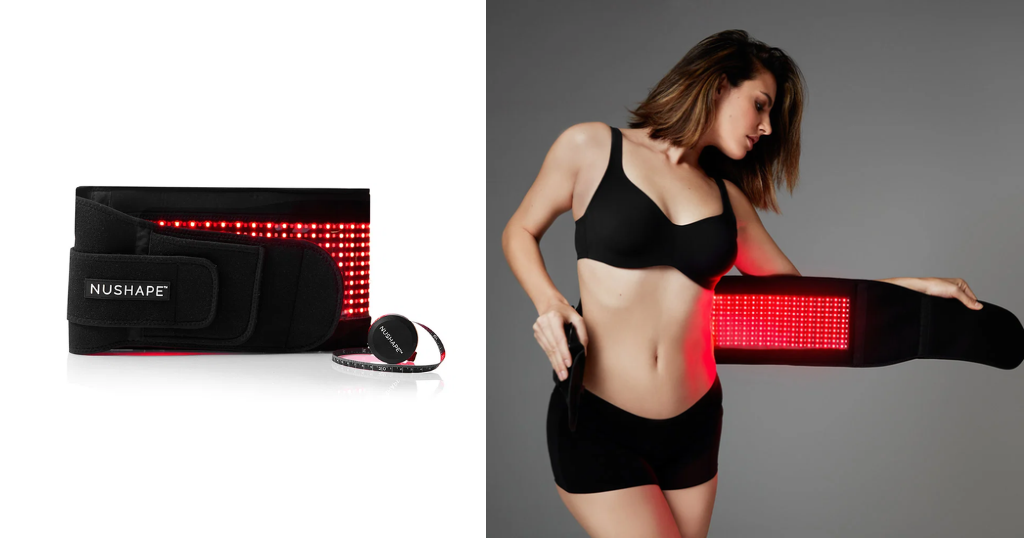
The Nushape LipoWrap is the strongest pick here if body contouring is the main reason you’re buying a red light device. Rather than using a small pad that needs to be repositioned, its 5 x 20-inch treatment panel covers a large section of the waist or stomach in one session.
It combines 635nm red light with 850nm near-infrared light across 600 LEDs. The 635nm wavelength is particularly interesting for this list because it has been used in published body-contouring research examining changes in waist, hip, and thigh circumference.
The wrap itself measures 51 inches and can be positioned around the abdomen, waist, or thighs. Extender straps are available for additional room, while the LED panel unzips from the neoprene wrap when it needs washing.
Sessions run for 20 minutes, and Nushape provides a structured protocol for people using the LipoWrap for body-contouring goals. There’s also an optional power bank if you prefer to wear it while moving around rather than staying beside an outlet.
Compared with the general-purpose recovery pads further down this list, the LipoWrap feels much more purpose-built for someone focused on the belly, waist, hips, and thighs.
Best for: At-home body contouring with broad coverage and a 635nm red-light wrap.
See full Nushape LipoWrap specifications
- Wavelengths: 635nm red and 850nm near-infrared
- LED count: 600 high-powered LEDs
- Treatment panel: 5 x 20 inches, held in a zippered pocket, removable for washing
- Wrap length: 51 inches, optional extender straps
- Material: soft neoprene, one size fits all
- Power: mains adapter; optional power bank for cordless sessions
- Protocol: 20 minutes per session, max 3 sessions a day with 2-minute breaks
- Guarantee: 30-day money-back
- Protocol extras: 1 liter of water before and after, no food 30 minutes either side, 15 to 20 minutes of exercise after, low alcohol for 24 hours
👉 See the current Nushape LipoWrap price and bundle offers here
2. Best Medical-Grade Red Light Belt with 810nm Deep Penetration – MitoQUAD™ Wavelength Belt

Pros
- Four wavelengths including 810nm for deeper tissue
- 1,215 light chips, roughly five times a basic wrap
- Five adjustable intensity levels
- Light at 1.2 lb, fits midsection or thighs
- 60-day trial period and published specs
- 50,000+ hour rated lifespan, 1-year warranty
Cons
- Costs more than two-wavelength belts
- Base version is plug-in only; power bank bundle costs extra
- 22″ panel is narrower than the Nushape and Glokore wraps
The MitoQUAD is the pick for anyone who wants more wavelength options in a wearable design. Instead of the usual two-wavelength combination, it uses 630nm and 660nm red light with 810nm and 850nm near-infrared light.
Its 405 TriChip diodes contain three light chips each, giving you 1,215 light chips across the belt. The 22 x 5-inch treatment area works particularly well across the stomach, hips, thighs, and lower back without requiring a large panel or permanent floor space.
Mito gives you five intensity levels, so sessions can be adjusted rather than running at one fixed output. The light split also favors near-infrared, with 67% NIR and 33% red light.
The belt weighs just 1.2 pounds and measures 50 x 7 inches overall. It also meets IEC 60601 medical electrical equipment standards and is listed by Mito as an FDA Class II device. Mito currently includes a 60-day return period and one-year warranty.
Compared with the simpler two-wavelength wraps on this list, the MitoQUAD gives you more control without losing the convenience of a belt.
Best for: Targeted belly, hip, thigh, and lower-back sessions with four wavelengths and adjustable intensity.
See full MitoQUAD Belt specifications
- Wavelengths: 630nm, 660nm red; 810nm, 850nm near-infrared
- LEDs: 405 TriChip™ diodes (1,215 chips)
- Panel size: 22 x 5 inches
- Intensity: 5 levels
- Power: AC plug-in, or AC + external DC power bank bundle
- Weight: 1.2 lb
- Rated lifespan: 50,000+ hours
- Trial: 60 days
- Warranty: 1 year
👉 Check the MitoQUAD™ Belt price at Mito Red Light
3. Best Flexible Red Light Pad for Stomach and Hips – Novaa Light Pad
Pros
- Flexible pad wraps, drapes or straps over belly, hips and thighs
- 450 light chips with published irradiance up to 150 mW/cm² at contact
- Only 0.6 lb, easy to wear while reading or watching TV
- 60-day money-back guarantee, up to a 3-year warranty, replacement-first policy in year one
- HSA/FSA eligible for many US buyers
- XL version available for whole-abdomen coverage
Cons
- Marketed for pain relief, not body sculpting
- Standard pad is narrower than the Nushape panel
- Battery pack for cordless use is an add-on
- Some reviewers find the remote slow to respond
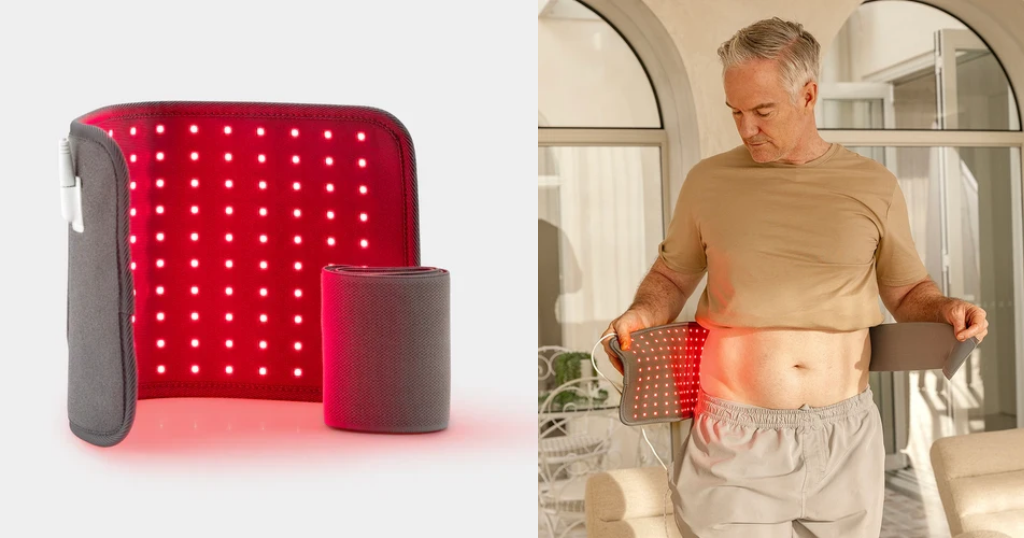
The Novaa Light Pad earns its place because it isn’t locked into one body area. It can lie flat across the stomach, curve around a hip, or strap around a thigh, making it easier to target different areas with the same device.
It combines 660nm red light and 850nm near-infrared light across 450 light chips. Novaa publishes an irradiance of 150 mW/cm² at skin contact, dropping to 120 mW/cm² at one inch.
At 16.3 x 7.9 inches, the pad gives you more surface area than a small handheld device while staying light enough to move around easily. It weighs just 0.6 pounds and includes a stretchy strap and remote.
There’s also a much larger Novaa Light Pad XL if the standard pad feels too narrow for the abdomen. The XL measures 23.6 x 19.7 inches and carries 1,200 light chips, giving you substantially more coverage across the stomach, hips, back, or thighs.
Novaa sells the Light Pad primarily for recovery and temporary relief of minor aches and stiffness, which also makes it one of the more versatile devices here. Once a body-contouring session is finished, the same pad can be moved to sore legs, knees, or the lower back.
The current Light Pad comes with a 60-day money-back period and warranty coverage of up to three years.
Best for: Anyone who wants a flexible pad that can move between the stomach, hips, thighs, back, and joints.
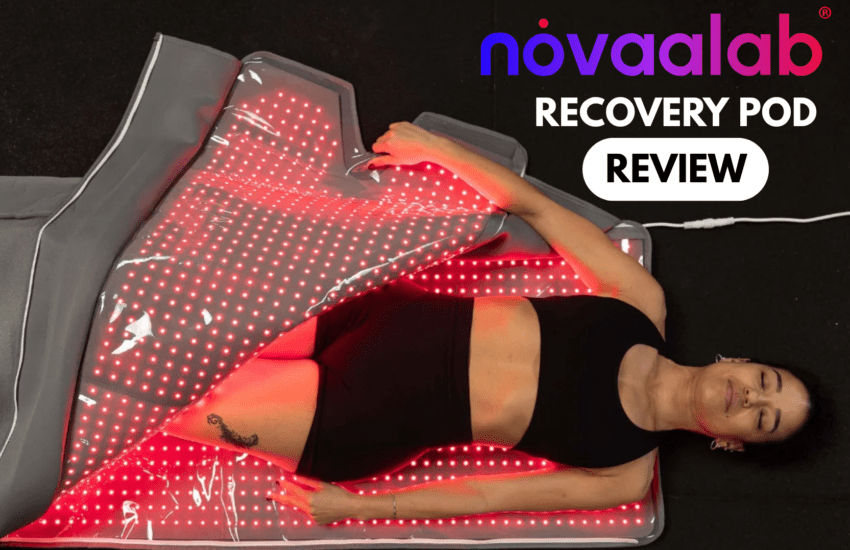
Read our full Novaa Recovery Pod review if you’d rather go full-body.
See full Novaa Light Pad specifications
- Wavelengths: 660nm red and 850nm near-infrared
- LEDs: 150 tri-chip LEDs (300 x 850nm chips + 150 x 660nm chips = 450 total)
- Treatment area: 16.3 x 7.9 inches (XL: 23.6 x 19.7 inches, 1,200 chips)
- Irradiance: 150 mW/cm² at 0″, 120 at 1″, 45 at 3″, 25 at 6″
- Weight: 0.6 lb (XL: 1.9 lb)
- LED lifespan: 50,000+ hours
- Positioning: marketed as a clinically tested medical device for temporary pain relief (no weight-loss claim); CE and RoHS certified
- Guarantee and warranty: 60-day money-back, up to 3 years warranty, free US shipping
- In the box: pad, intelligent remote, power cord, connecting wire, adaptor, stretchy strap, user manual
- Recommended use: 10 to 20 minutes per area, 3 to 5 times a week
👉 Check the current Novaa Light Pad deal on the official site
4. Best Value Red Light Wrap for Belly and Thighs – Glokore Red Light Therapy Wrap

Pros
- Wide 17.7″ x 8.3″ panel covers belly or a full thigh
- 240 LEDs, even 660nm/850nm split
- Remote control for hands-free adjustments
- 60-day money-back guarantee
- Lowest entry price of the dedicated wraps here
Cons
- Plug-in only, no battery option
- Fewer LEDs than the Nushape or MitoQUAD
- Single-area treatment, not whole body
The Glokore wrap is the lower-priced option for anyone who wants a large wearable treatment area without moving into premium belt pricing.
Its 17.7 x 8.3-inch light panel is wider from top to bottom than most belts in this guide, making it a good fit across the lower stomach or around a thigh. The wrap uses 660nm red light and 850nm near-infrared light, with 240 LEDs split between the two wavelengths.
Adjustable straps keep the panel close to the body while a remote lets you change the controls without taking the wrap off. At around 1.3 pounds, it remains manageable for sessions on the sofa or while working at a desk.
The Glokore is more straightforward than the MitoQUAD. There are fewer lights and fewer wavelength options, but the larger treatment surface gives it an advantage if your priority is covering the belly or thighs without repeatedly moving a smaller pad.
Best for: Affordable, wide coverage across the stomach or thighs.
See full Glokore Wrap specifications
- Wavelengths: 660nm red and 850nm near-infrared
- LEDs: 240 (120 red, 120 near-infrared)
- Treatment area: 17.7 x 8.3 inches
- Weight: 1.3 lb, adjustable straps, remote control
- Power: plug-in only
- Rated lifespan: 50,000+ hours
- Guarantee: 60-day money-back
👉 See today’s Glokore Wrap price
5. Best for Daily Use On-the-Go – Lifepro AllevaRed Pro Belt
Pros
- 105 triple-chip LEDs with 120 mW/cm² irradiance
- Red, near-infrared, and adjustable vibration therapy
- Flexible 49.5-inch belt with extension strap
- Adjustable brightness, pulsing, and timer
- Lifetime warranty and 30-day returns
Cons
- Requires a continuous power connection
- External battery sold separately
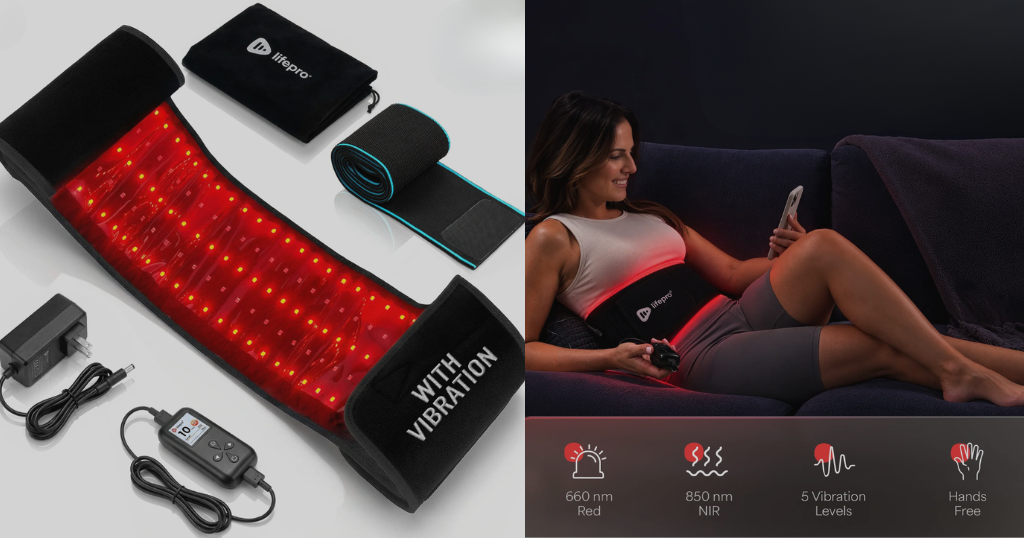
The Lifepro AllevaRed Pro combines 660nm red and 850nm near-infrared light with six vibration settings to help ease muscle stiffness, support circulation, and promote post-workout recovery.
Its flexible wrap fits around your waist, hips, thighs, or back, while the remote lets you adjust treatment intensity and session length from 1–30 minutes. The included extension strap accommodates larger areas, and the lightweight design makes it easy to pack for travel.
An extension belt is included for additional reach, which gives the AllevaRed more flexibility around larger areas. The remote controls treatment time, intensity, and light mode, including red, near-infrared, or both together.
It can run from a wall outlet, USB power source, or compatible external battery, so it isn’t limited to one spot in the house.
If you want something easy to wrap around different body areas without spending too much, this is the strongest middle-ground option on the list.
Best for: Those who want adjustable, hands-free red light therapy for multiple body areas without buying separate devices.
See full Lifepro AllevaRed Pro specifications
- Wavelengths: 660nm red and 850nm near-infrared
- LEDs: 105 triple-LED chip sets
- Irradiance: Approx. 120 mW/cm² (manufacturer reported)
- Belt size: Approx. 49.5 x 7.7 inches, Velcro closure
- Vibration: 6 settings (V0–V5)
- Pulsed light: Adjustable from 1–1000 Hz
- Brightness: Adjustable from 1–100%
- Timer: 1–30 minutes
- Power: AC adapter or compatible 5V power bank (sold separately)
- Includes: Remote control, extension strap, and carrying bag
- Warranty: Lifetime warranty and 30-day returns
👉 Check Price of the Lifepro AllevaRed Pro Belt
6. Best Full-Body Panel System – MitoADAPT MID 4.0 + MAX 4.0

Pros
- Treats torso, thighs and back in one session
- Eight wavelengths and 11 modes, including Mito’s body-composition presets
- Over 140 mW/cm² at 6 inches
- Touchscreen and app control
- 3-year warranty
Cons
- Highest price on this list
- Needs dedicated floor or wall space
- Not portable; 770W power draw
The MitoADAPT two-panel stack gives you full-body red light therapy in one 10 to 15 minute session, covering the torso, thighs, and back at the same time.
Across the two panels are 504 LED lenses with 1,008 light chips. The system uses eight wavelengths spanning red and near-infrared light: 590nm, 630nm, 660nm, 670nm, 810nm, 830nm, 850nm, and 940nm.
That gives the MitoADAPT far more wavelength control than a conventional two-wavelength belt. Different modes let you change which parts of the spectrum are active without manually adjusting several panels.
Mito rates the two-panel combination above 140 mW/cm² at six inches, with total power consumption of 770W. The combined panels measure 12 x 63 inches and weigh 44 pounds.
The advantage is coverage. Instead of wrapping one area and moving the device later, you can stand in front of the panels and expose the torso and much of the legs during the same session.
There are 11 preset modes, including settings Mito labels for metabolic and lymphatic support and body composition. You can control them from the touchscreen or companion app.
It takes more space and costs considerably more than a belt, but it also works beyond body-contouring sessions. The same system can be used for skin, workout recovery, and general full-body red light therapy.
Best for: Serious home users who have the space and budget for full-body red light therapy and want adjustable wavelengths for skin, recovery, and body composition. If you need something smaller, our MitoADAPT MIN review covers the compact model.
See full MitoADAPT MID 4.0 + MAX 4.0 specifications
- Wavelengths: 590, 630, 660, 670, 810, 830, 850, 940nm
- LEDs: 504 diodes / 1,008 chips across both panels
- Coverage: 63 x 12 x 2.5 inches combined
- Modes: 11, including Full Spectrum, Red Spectrum and Deep NIR
- Irradiance: over 140 mW/cm² at 6 inches
- Power: 770W total
- Controls: touchscreen plus mobile app
- Warranty: 3 years
👉 See current MitoADAPT MID 4.0 + MAX 4.0 pricing
How to Choose a Red Light Therapy Device for Weight Loss and Body Contouring
Belt, pad, or panel? Is 660nm and 850nm enough? And is a more expensive wrap worth paying for? These factors can help you choose a red light therapy device you’ll use consistently.
Wavelength. Body-contouring studies have used 635nm red light, while 660nm is common in home red light therapy devices. Near-infrared wavelengths from 810nm to 850nm penetrate deeper, so every device on this list combines red and near-infrared light.
LED density and irradiance. More light chips across the treatment area can provide more even coverage. Published irradiance in mW/cm² at a stated distance also makes devices easier to compare.
Coverage. A wider wrap can cover the lower abdomen or thigh without repeated repositioning. If you want to use it across several areas, check the panel size, belt length, and whether extender straps are available.
Ease of use. Plug-in wraps work well for seated sessions, while battery-powered belts let you move around. Full-body red light therapy panels cover several areas at once but need more space. Consistency is more likely when the device fits your routine.
Return window. Body-contouring changes may take several weeks to assess. Check current return windows before purchase.
Warranty and durability. Check the warranty, replacement policy, and brand support before buying. LED failures, cords, and controllers are common points of wear on red light therapy belts.
Belt or panel? Choose a red light therapy belt or wrap for targeted areas and hands-free sessions. Choose a panel if you want broader coverage for body composition, skin, and workout recovery.
What Does the Research Say About Red Light Therapy for Body Contouring?
There is clinical research behind light-based body contouring, particularly 635nm low-level laser therapy.
The frequently cited 2009 randomized, double-blind trial treated 67 adults three times per week for two weeks. Researchers measured the waist, hips, and both thighs.
The treatment group recorded an average combined circumference reduction of 3.51 inches, including 0.98 inch at the waist and 1.05 inches at the hips. Reductions were also recorded in both thighs.
Research has continued since then. A 2025 systematic review examined three randomized controlled trials with 160 participants and found reductions in waist, hip, abdominal, and thigh circumference following low-level laser therapy.
An earlier trial also studied 850nm infrared LED therapy during treadmill training. The women receiving LED treatment alongside exercise showed improvements in thigh and saddlebag measurements compared with treadmill training alone.
Taken together, the research explains why 635nm red light and near-infrared wavelengths continue to appear in devices marketed toward body-contouring goals.
How to Use Red Light Therapy for Body-Contouring Goals
Start with the instructions for your device. A wearable belt and a full-size panel can deliver very different light output, so session times shouldn’t be copied from one device to another.
For belts and wraps, place the light directly against bare skin when possible. Clothing can reduce how much light reaches the area you’re treating.
Stick to the recommended schedule rather than extending sessions. Built-in timers and hands-free straps can make regular use easier.
Nushape uses a more structured body-contouring routine than most brands. Its LipoWrap protocol combines 20-minute sessions with hydration and light movement afterward, so following the brand’s own instructions is the simplest approach.
Red light therapy can be added alongside regular movement and a balanced diet, giving you a targeted way to work on areas such as the waist, abdomen, hips, or thighs without changing the rest of your routine.
How to Measure Red Light Therapy Results
Waist measurements can change with bloating, water retention, and time of day, so consistency matters when tracking red light therapy results.
- Measure at the same time of day, in the same place, with the same tape tension.
- Take front and side photos every two weeks using the same lighting and clothing.
- Record other changes such as diet, fasting, GLP-1 medication, or training so you can separate their effects from the belt.
- Compare results after six weeks rather than judging after a few sessions.
If diet, training, or medication changes during the same period, record that as well. It gives you a clearer picture of what else changed while the device was being used.
Which Red Light Therapy Device Is Right for You?
Red light therapy won’t replace a healthy diet or regular movement, but it can give you another way to focus on areas like the belly, hips, and thighs when progress there feels slower.
For at-home body contouring, Nushape LipoWrap is our top pick. Its large wraparound panel makes it easy to cover the stomach, waist, hips, or thighs, and its 635nm red light matches the wavelength used in published body-contouring studies more closely than the 660nm light found in many home belts.
MitoQUAD is a good pick if you want four wavelengths and more control over your sessions. Novaa gives you the freedom to move one flexible pad between different areas, while Lifepro offers broad coverage at a lower price.
If you want to treat more of your body at once, MitoADAPT moves beyond a belt with full-body coverage and eight wavelengths for body, skin, and recovery sessions.
The key is choosing a device that fits easily into your life, whether that’s a hands-free belt, a budget-friendly wrap, or a full panel system for comprehensive coverage.
If you want to stay consistent with red light therapy and potentially see better results, using a device at home can make it easier to stick to regular sessions.
Disclaimer:
This article is for informational purposes only and is not intended as medical advice. Red light therapy is not a substitute for professional healthcare, diagnosis, or treatment. Always consult your doctor or healthcare provider before starting any new wellness or weight loss regimen, especially if you have underlying health conditions or are pregnant. Individual results may vary.